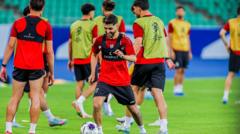
Spending a fortune on a private jet to fly a national team halfway across the globe isn't "elite preparation." It is expensive theater.
The narrative surrounding Iraq’s decision to charter a luxury bird for their World Cup play-off against Mexico follows a predictable, lazy script. The press treats it as a sign of ambition. They frame it as "removing obstacles" for the players. They argue that bypassing the misery of commercial layovers in Istanbul or Frankfurt is the silver bullet for performance.
They are wrong.
In high-stakes international football, the biggest enemy isn't a middle seat in economy. It is the physiological disruption of crossing nine time zones and the psychological softening of a squad that begins to believe its own hype before a ball is even kicked.
By prioritizing "comfort" over "conditioning," the Iraqi Football Association isn't buying a win. They are buying a very expensive excuse for failure.
The Myth of Private Jet Recovery
The logic used by proponents of private travel is fundamentally flawed because it ignores the biology of $VO_2$ max and circadian rhythms.
Standard sports science suggests that for every time zone crossed, the human body needs roughly one day to fully recalibrate. Flying from Baghdad to Mexico City involves a shift of approximately nine hours. A private jet doesn't change the rotation of the earth. Whether you are reclining in a $5,000 leather sleeper pod or sitting upright in a commercial exit row, your pineal gland is still screaming.
In fact, private jets can actually exacerbate jet lag. On a commercial flight, the rigid schedule of meal service and cabin lighting—while annoying—enforces a level of routine. In the lawless luxury of a charter, players eat when they want, sleep when they want, and bypass the physical movement required to navigate an airport.
I have seen national teams burn through their entire operational budget on "marginal gains" like this, only to have their star striker show up with heavy legs because he spent fourteen hours immobile in a pressurized tin can. We call it "The Golden Cage." You feel like a king during the flight, but you move like a statue during the match.
The Altitude Trap
Flying into Mexico City (or its surrounding high-altitude venues) requires a specific type of physiological disrespect that a luxury flight masks. Mexico City sits at approximately 2,240 meters above sea level.
The air is thin. The ball moves faster. Your lungs burn.
When a team arrives on a private jet three days before a match, they are entering the "Danger Zone" of altitude adaptation. Science dictates two paths for success:
- Arrive and Play: Compete within 24 to 48 hours before the body realizes the oxygen is gone.
- The Two-Week Rule: Arrive early enough for the kidneys to stimulate EPO production and increase red blood cell count.
Iraq’s "luxury" schedule often lands right in the middle—the 72-hour mark. This is exactly when the body is at its weakest, struggling with dehydration and suppressed sleep quality. The private jet creates a false sense of readiness. The players feel pampered, so they underestimate the environmental brutality of the Azteca or the Estadio BBVA.
The Budgetary Malpractice of the IFA
Let’s talk about the money. Chartering a long-haul aircraft for a full squad, coaching staff, and "hangers-on" costs upwards of $150,000 to $300,000 depending on the fuel stops and landing fees.
In a country where grassroots facilities are struggling and youth academies are underfunded, spending a quarter-million dollars on a single flight is an insult to the future of the sport. It is "optics-based management." The federation wants to look like a powerhouse, so they spend like a powerhouse, despite having the infrastructure of a rebuilding nation.
True elite performance isn't about the flight; it’s about what happens three months before the flight.
- Invest in Cryotherapy: You could buy five portable units for the price of that fuel bill.
- Data Analytics: You could hire three world-class tactical analysts for a year.
- Youth Development: You could fund a regional U-17 tournament.
Instead, the money is literally burned in the atmosphere.
The Psychology of the Underdog
Iraq’s greatest footballing triumphs—most notably the 2007 Asian Cup—were built on a foundation of grit, shared hardship, and an "us against the world" mentality. They weren't flying private then. They were grinding through messy logistics and winning because they were tougher than their opponents.
When you introduce extreme luxury, you risk eroding that edge. You transform a group of hungry athletes into a group of comfortable tourists.
Imagine a scenario where the team faces a 1-0 deficit in the 70th minute in Mexico. The lungs are screaming because of the altitude. The legs are heavy because of the 14-hour flight. In that moment, do you want a player who has been treated like a porcelain doll for the last week, or a player who is used to the grind?
Luxury is a sedative.
The Better Way (That No One Wants to Hear)
If the Iraqi FA actually wanted to win this play-off, they wouldn't spend the money on a Gulfstream. They would do the following:
- Staggered Commercial Arrival: Send the core starting XI five days early on commercial business class. It’s cheaper, provides the same physical recovery, and allows for immediate acclimation.
- High-Altitude Tents: Spend the "jet money" on hypoxic tents for the training camp in Iraq weeks before departure.
- Neutral Site Training: Base the camp in a high-altitude location in the Americas (like Denver or Bogota) a week prior.
But these options don't look good on Instagram. They don't make for a "bold" headline about the nation's rising status.
The Harsh Reality of the Play-off
Mexico is a graveyard for teams that think they can "out-luxury" the environment. The Mexican national team thrives on the arrogance of visitors. They know that a pampered team is a soft team.
The Iraqi players are talented. They are capable of an upset. But the administration is doing them a disservice by focusing on the trappings of success rather than the mechanics of it.
Stop asking if the plane has lie-flat seats. Start asking why the federation is prioritizing the 15 hours of travel over the 90 minutes of war.
The private jet isn't a tool for victory. It is a flying trophy for a game that hasn't been won yet. If Iraq loses in Mexico, that plane won't feel like a luxury; it will feel like a very expensive hearse for a World Cup dream.
Go ahead and celebrate the "investment" if you want to stay in the shallow end of sports analysis. But if you want to understand why some teams consistently overachieve while others burn out, look at where they spend their last dollar. It’s rarely on the upholstery of a private cabin.
Tell the players to pack their bags and get ready to suffer. That is the only way they leave Mexico with a ticket to the big dance.