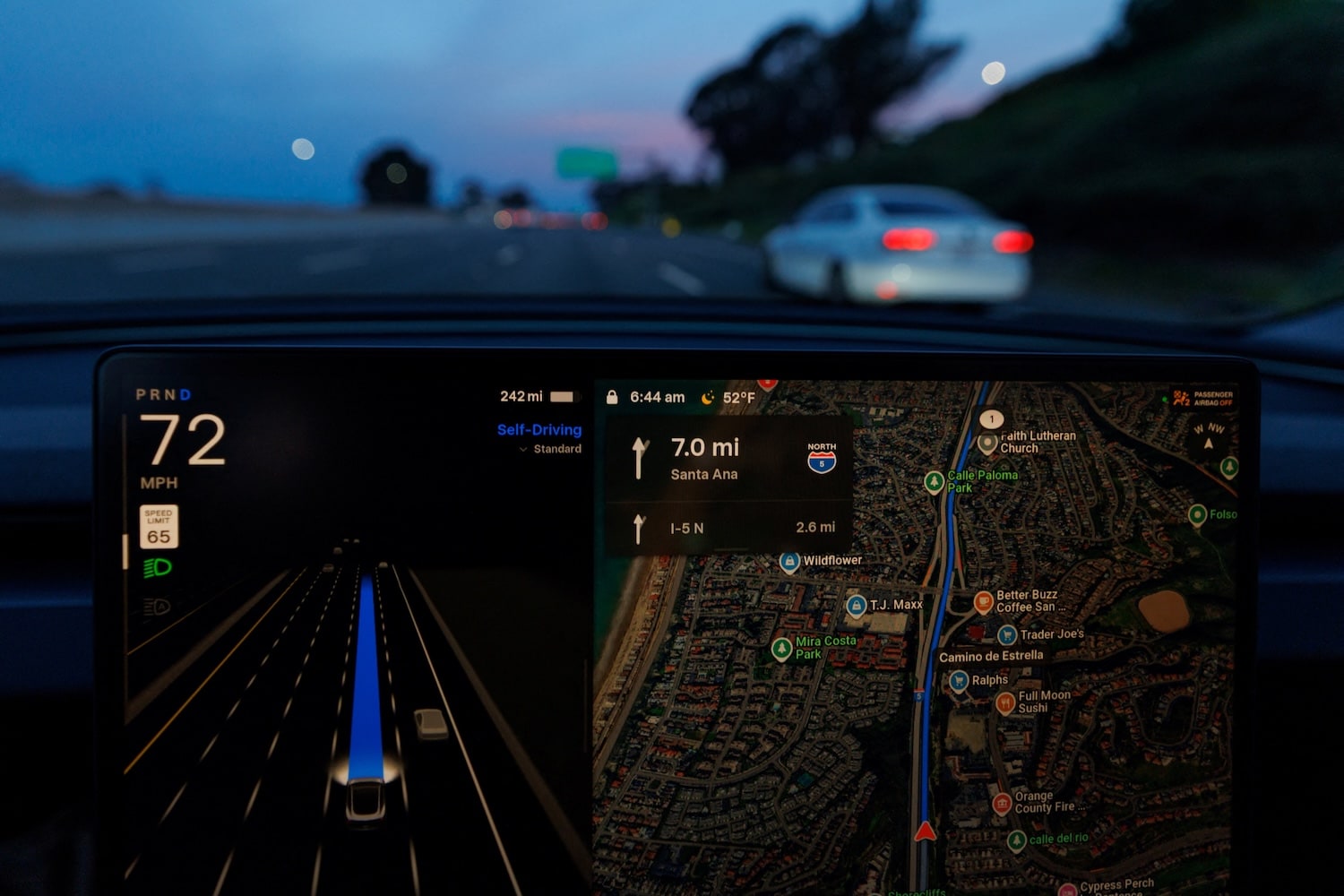
The expansion of the National Highway Traffic Safety Administration (NHTSA) investigation into Tesla’s Full Self-Driving (FSD) software to encompass 2.4 million vehicles—following four reported crashes in low-visibility conditions—marks a transition from isolated incident review to a systemic audit of computer vision reliance. This probe does not merely evaluate a software version; it tests the fundamental hypothesis that a camera-only sensor suite can achieve localized safety parity with human drivers across all edge cases. The failure of these systems to respond to "reduced roadway visibility conditions" such as sun glare, fog, and airborne dust reveals a deterministic bottleneck in Tesla's current hardware-software integration.
The Sensor Fusion vs. Pure Vision Tradeoff
The core of the NHTSA’s Engineering Analysis (EA) focuses on the "Vision Only" architecture. Unlike competitors who utilize a "Sensor Fusion" model—combining LiDAR, radar, and cameras—Tesla removed radar from its production line in 2021 and ultrasonic sensors in 2022. This decision was predicated on the belief that a neural network trained on massive datasets could replicate the human biological vision system.
However, the "reduced visibility" crashes highlight a divergence between human biological processing and artificial neural networks. While a human driver uses contextual inference and depth perception honed by millions of years of evolution to navigate fog, a vision-based AI relies on pixel-level contrast. When environmental factors like sun glare or thick dust saturate or obscure those pixels, the system loses the primary data stream required for object detection and path planning.
The reliance on vision creates a specific failure mode: the "Blind Spot" of high-contrast light. In the four incidents cited by NHTSA, including one fatal crash where a pedestrian was struck, the system failed to reduce speed or initiate evasive maneuvers. This suggests that the software did not "see and fail to react," but rather "failed to perceive an object at all" because the environmental noise exceeded the sensor's dynamic range.
The Three Pillars of Autonomy Failure
To quantify the risk currently under investigation, the problem must be deconstructed into three distinct vectors: Perception Latency, Operational Design Domain (ODD) Violations, and the Automation Paradox.
- Perception Latency in Low-Contrast Environments: In fog or dust, the signal-to-noise ratio drops. For a Vision Only system, the compute required to distinguish a stationary object from a hazy background increases exponentially. If the system's confidence threshold is set too high, it ignores the obstacle; if set too low, it triggers "phantom braking." The recent crashes suggest a calibration that favors fluidity (avoiding false positives) at the expense of safety (ignoring true positives).
- Operational Design Domain (ODD) Boundaries: Tesla markets FSD as "Full Self-Driving (Supervised)," which creates a legal and technical gray area. The ODD is the specific conditions under which a system is designed to function. By failing in fog and glare, FSD is demonstrating that its ODD is narrower than the marketing suggests. The NHTSA investigation is essentially an attempt to force a formal definition of these boundaries.
- The Automation Paradox: This is a human-factors engineering problem. As a system becomes more capable, the human operator becomes less attentive. When the system eventually hits an edge case it cannot handle—like a sudden dust storm—the human driver, who has been lulled into a state of passive monitoring, cannot regain situational awareness quickly enough to intervene.
Quantifying the Recall Scope and Economic Friction
The investigation covers nearly every Tesla vehicle sold in the United States since 2016 that is equipped with FSD or Autopilot. This creates a massive potential liability, not just in terms of software patches, but in hardware retrofitting.
If the NHTSA concludes that camera-only systems are fundamentally incapable of safe operation in low-visibility environments without redundant sensors (like LiDAR or Radar), the remedy could be catastrophic for Tesla's margin structure. A software-based recall is a low-cost over-the-air (OTA) update. A hardware-based mandate—requiring the re-installation of radar or improved camera modules—would cost billions.
The financial markets have historically ignored these probes, viewing them as "regulatory noise." However, the current probe (EA24-003) is different because it directly challenges the viability of the "Robotaxi" business model. A Robotaxi cannot require a human supervisor to take over in the fog. If the hardware cannot solve for fog, the Robotaxi remains a theoretical asset rather than a functional one.
The Mechanism of Failure: Why FSD Struggles with Glare
The technical limitation of CMOS (Complementary Metal-Oxide-Semiconductor) sensors, used in Tesla cameras, involves dynamic range. When driving into a setting sun, the light intensity can be 100,000 times brighter than the shadows on the road. While human eyes can adjust, cameras often "blow out," turning a critical portion of the visual field into pure white pixels.
In the reported fatal crash, the vehicle was operating in a region where sun glare was likely a factor. Without a secondary sensor like Radar (which uses radio waves that pass through glare, fog, and dust) or LiDAR (which uses its own light source to map depth), the vehicle is effectively driving blind during those milliseconds of saturation. The software's inability to "anticipate" this loss of data and proactively reduce speed is the specific failure of logic being scrutinized.
Regulatory Pressure and the Path to Level 4
NHTSA’s shift toward a more aggressive stance reflects a broader move to regulate "AI in the wild." For years, the agency allowed Tesla to "beta test" software on public roads with minimal interference. The new investigation signals a move toward "Performance-Based Standards."
The agency is asking two critical questions:
- Does the system adequately detect when its own sensors are compromised by weather?
- Does the system issue a "Handover Request" with sufficient lead time for the human to react?
The second question is the most damning. If the system fails to recognize that it is failing, the human is never alerted. This "silent failure" is the primary target of the federal probe.
Strategic Implications for the Autonomous Vehicle (AV) Sector
The outcome of this investigation will set the precedent for how all autonomous systems are evaluated. If Tesla is forced to restrict FSD usage during specific weather conditions via geofencing or sensor-blocking software, it creates a tiered utility model for AVs.
- Operational Constraints: Vehicles may be software-locked from activating FSD if the onboard barometer, wipers, or camera contrast sensors detect sub-optimal conditions.
- Liability Shift: A formal finding of "systemic inadequacy" in low visibility would shift the legal burden from the driver to the manufacturer in subsequent civil litigation.
- Hardware Re-convergence: We may see a "Return to Radar." Recent rumors of "Hardware 5" (AI 5) suggest Tesla is exploring higher-resolution sensors and potentially reintegrating high-definition radar to solve these exact edge cases.
The Cost of Data Supremacy
Tesla’s defense has always been its data moat—billions of miles driven by its fleet. But data quantity does not always solve for data quality. If 99% of those miles are driven in clear weather, the neural network remains "under-trained" for the 1% of miles driven in extreme glare or fog. This is the "Long Tail" problem of autonomous driving.
The current NHTSA probe is a forced confrontation with that Long Tail. It suggests that the path to true Level 4 autonomy cannot be paved with cameras alone. The physics of light propagation through the atmosphere imposes a hard limit on what a 2D image-processing system can achieve.
Tesla must now demonstrate that its software can predict environmental sensor degradation before it occurs. This requires an "Environmental Awareness" layer that operates independently of the "Object Detection" layer. If the cameras detect a loss of contrast, the system must logically conclude that its "world model" is no longer reliable and immediately initiate a safe-state transition (reducing speed and increasing following distance).
The strategic play for Tesla is a preemptive software update that introduces aggressive "Visibility Throttling." By voluntarily limiting FSD's functionality in high-glare or low-light scenarios through more sensitive sensor-health monitoring, the company could mitigate the risk of a federally mandated hardware recall. This would prioritize regulatory compliance over the "feature-complete" marketing narrative, effectively acknowledging that the Vision Only hypothesis requires significant environmental guardrails to remain viable on public roads.