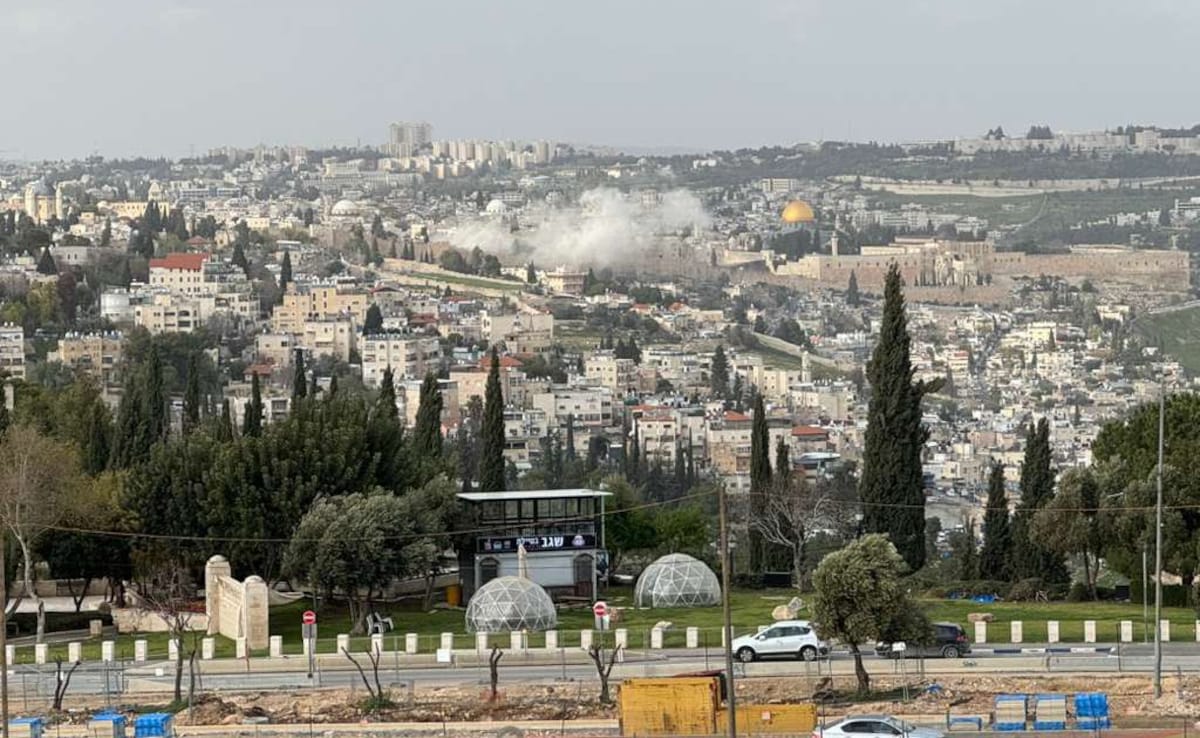
The intersection of ballistic trajectory and religious geography creates a volatility coefficient that traditional military analysis often overlooks. When an Iranian medium-range ballistic missile (MRBM) enters the terminal phase above Jerusalem, the margin of error—measured in mere decimeters—dictates the difference between a tactical strike and a global geopolitical transformation. The recent deployment of Iranian ordnance during Eid al-Fitr, specifically impacting within the immediate proximity of the Al-Aqsa Mosque, provides a raw data set for evaluating the "Circular Error Probable" (CEP) of the Fattah or Kheibar-type delivery systems against the strategic intent of the Islamic Revolutionary Guard Corps (IRGC).
The Mechanics of Proximity and Precision
Military doctrine defines precision through the CEP, a measurement indicating the radius of a circle within which 50% of missiles are expected to land. For older SCUD-variant systems, this radius often exceeded 500 meters. Modern Iranian guidance systems, leveraging Global Navigation Satellite Systems (GNSS) and Inertial Navigation Systems (INS), claim a CEP of 10 to 50 meters.
The landing of a missile "meters" from the Al-Aqsa Mosque suggests three distinct technical possibilities:
- Intentional Near-Miss: The use of a holy site as a "kinetic shield," where the projectile is aimed close enough to trigger psychological terror without risking the catastrophic blowback of destroying a primary Islamic landmark.
- Terminal Phase Failure: A malfunction in the maneuverable re-entry vehicle (MaRV) where the guidance vanes failed to compensate for atmospheric density or high-altitude winds during the final descent.
- Active Interception Variance: The impact may not represent the intended target, but rather the "debris footprint" of a successful interception by the Arrow-3 or David’s Sling systems. When a kinetic kill vehicle strikes a ballistic warhead, the resulting trajectory of the remaining mass is dictated by conservation of momentum, often shifting the impact point by several hundred meters from the original calculation.
The Triad of Deterrence Erosion
The presence of Iranian-manufactured hardware in the airspace above Jerusalem represents a fundamental shift in the regional "Deterrence Equation." This equation relies on the perceived cost of escalation versus the probability of mission success.
The Cost of Symbolic Desecration
If a missile were to strike the Al-Aqsa Mosque, the IRGC would face an immediate legitimacy crisis within the Muslim world. This creates a "Red Line Paradox." Iran must demonstrate the capability to reach Jerusalem to maintain its domestic and proxy-network prestige, yet it cannot afford the precision error that would lead to the destruction of the very site it claims to "liberate." The Eid al-Fitr timing amplifies this risk, turning a technical mission into a high-stakes theological gamble.
Interception Saturation Logic
The Israeli Integrated Air and Missile Defense (IAMD) architecture operates on a tiered priority list. Defenders must make instantaneous choices: which incoming threats pose a risk to human life or critical infrastructure, and which can be allowed to impact in "open areas." The Temple Mount is technically an "open area" in terms of population density at 3:00 AM, but its symbolic density is infinite. An interceptor battery commander faces a split-second optimization problem: do you fire a million-dollar interceptor at a missile projected to hit a courtyard, or save it for a missile headed for a power plant?
The Intelligence-Kinetic Loop
The proximity of the impact demonstrates a narrowing of the "Sensor-to-Shooter" gap. To achieve an impact within meters of a specific structure after a 1,500-kilometer flight path requires high-fidelity topographical mapping and real-time corrections. This suggests that Iranian telemetry is no longer relying solely on pre-programmed coordinates but may be utilizing terrestrial-based signal correction or advanced optical scene matching.
Structural Vulnerabilities in Urban Sanctity
Traditional hardened targets (bunkers, hangars) are designed to withstand overpressure. Religious and historical sites are "soft targets" with zero structural resilience against kinetic energy. A standard 500kg warhead impacting at Mach 3 carries enough kinetic energy to liquefy limestone foundations.
The "Secondary Effects" of such an impact include:
- Acoustic Overpressure: Even a near-miss shatters ancient stained glass and weakens the structural integrity of domes through vibrational resonance.
- Seismic Coupling: The energy transfer into the ground can collapse subterranean structures, such as the ancient cisterns and stables beneath the Al-Aqsa compound.
- Fragmentation Radius: Modern warheads use pre-formed fragments (tungsten or steel) designed to maximize lethality over a 300-meter radius. A landing "meters away" ensures the entire courtyard is razed by high-velocity shrapnel.
The Geopolitical Cost Function
The choice to launch during Eid al-Fitr serves as a "Force Multiplier" for the narrative. In strategic communication, the technical success of the missile is secondary to the visual evidence of it streaking across the sky above the Dome of the Rock. This creates a "Digital Kinetic Effect." Millions of social media impressions act as a secondary payload, bypassing the physical defenses of the state.
The failure of the international community to categorize "Symbolic Near-Misses" as a specific class of escalation allows the aggressor to test the boundaries of the IAMD without triggering a full-scale retaliatory strike. This "Grey Zone" operation utilizes high-end ballistic technology to achieve low-end psychological objectives.
Tactical Realignment and Defensive Calculus
Future defensive strategies must account for "Symbolic Protection Priority." This requires a re-weighting of the algorithms governing automated interceptor launches. If the system's logic is purely utilitarian (protecting the most lives per interceptor), symbolic sites remain vulnerable.
The shift from "Point Defense" (defending a specific base) to "Area Sanctity Defense" (defending a specific cultural coordinate) necessitates a higher density of interceptor batteries and a lower threshold for engagement. This, in turn, increases the "Economic Attrition" on the defender, as the cost of the interceptors significantly outweighs the cost of the attacking missiles.
The IRGC has signaled that no coordinate is technically or religiously "off-limits" for their ballistic testing. The proximity of the impact on Eid al-Fitr was not a failure of aim; it was a calibrated demonstration of the CEP. The strategic play now shifts to the defender: either accept the risk of a "statistical outlier" destroying a holy site or commit the overwhelming resource expenditure required to guarantee a 100% intercept rate over the Jerusalem basin.
The next phase of this conflict will not be defined by who has the most missiles, but by who can most effectively manage the "Risk of Error" in an environment where a 10-meter deviation is a historical catastrophe. Operators must now integrate cultural heritage mapping directly into the fire-control loops of the Arrow-3 batteries, ensuring that symbolic sites receive the same "Hardened Target" priority as nuclear reactors or command centers.