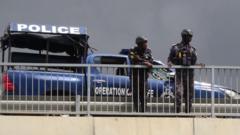
The tragedy hit the wires late last night. A Ghanaian footballer is dead after gunmen opened fire on a team bus in Libya. It’s the kind of headline that makes you feel sick. You want to believe sports provides a path out of poverty, but sometimes it leads straight into a war zone. This wasn’t a random accident. It was a targeted, violent ambush that highlights a massive, ignored problem in African football. Players are taking insane risks because the systems at home are broken.
Reports confirm the attack happened as the team traveled between cities for a match. Armed men intercepted the vehicle and started shooting. One Ghanaian player lost his life. Others are injured, some critically. We aren't just talking about a "security lapse" here. We’re talking about a fundamental failure to protect athletes in regions where stability is a ghost.
The Brutal Reality of the Libyan Football Circuit
Libya has been a magnet for West African players for years. Why? Money. Even in a country dealing with fractured governance and militia rule, the clubs pay better than most domestic leagues in Ghana or Nigeria. It's a gamble. A player looks at a contract in Tripoli or Benghazi and sees a chance to send money home to their parents. They see a way to buy a house. They don't always see the checkpoints, the shifting front lines, or the volatile security situation that can turn a routine road trip into a massacre.
This isn't the first time we've seen football and violence collide in the region. Remember the Togo national team bus attack in Angola back in 2010? We said "never again" then. Yet, here we are in 2026, and a young man who just wanted to play ball is coming home in a coffin. The Libyan Premier League has struggled with consistency for a decade. Matches get postponed. Stadiums are empty because of safety fears. But the recruitment of foreign talent never stops.
Why Ghanaian Players Keep Taking These Risks
If you ask a young talent in Accra why they’d go to a high-risk zone, they’ll give you a straight answer. "I have no choice." The Ghana Premier League (GPL) is struggling. Sponsorship is thin. Wages are often months late. When an agent calls with an offer from North Africa, it sounds like a lifeline. It’s hard to talk about "safety first" to a guy who can’t pay his rent.
The migration of talent is a one-way street. We’re losing our best legs to leagues that can’t guarantee they’ll return home after the 90 minutes are up. It’s a systemic rot. Until the GFA (Ghana Football Association) and CAF (Confederation of African Football) take a harder stance on where their players are being sent, these tragedies will keep happening. Honestly, it’s gut-wrenching.
The Failure of CAF to Regulate High Risk Leagues
Where is the oversight? CAF has a responsibility to vet the environments where its registered players compete. If a country can’t guarantee the safety of a team bus moving from Point A to Point B, that country shouldn't be hosting professional leagues. It sounds harsh, but how many bodies do we need to bury before we admit that some regions are currently "no-go" zones for professional sports?
Clubs in Libya often operate under the protection of local power brokers. Sometimes that protection is enough. Often, it isn't. When the bus was fired upon, where was the security detail? Most of these teams travel with minimal escort. They’re sitting ducks on open highways.
Security Protocols Are Not Optional
We need to stop treating security like a luxury. In Europe, a team bus is a fortress. In parts of Africa, it’s a Toyota Coaster with a dream and a prayer.
- Armored transport should be a requirement for teams traveling in known conflict zones.
- Real-time intelligence sharing between clubs and local authorities must happen before any wheels hit the tarmac.
- Flight-only mandates for certain routes where highway robbery and militia activity are rampant.
If a club can’t afford to fly its players or hire professional security, they shouldn't be allowed to play. Period. It’s better to go bankrupt than to lose a life.
The Human Cost Behind the Statistics
We often talk about these players as "exports." Like they’re cocoa or gold. They’re kids. Most are in their early twenties. They have families who stayed up late waiting for a WhatsApp message that never came. This latest victim was someone’s son, someone’s brother. He wasn't a soldier. He was a midfielder.
The trauma for the survivors is going to be massive. Imagine sitting next to your teammate and watching him die because of a bullet meant for anyone and no one. That stays with you. The physical wounds might heal, but the psychological damage of an armed ambush effectively ends a career anyway. Who wants to get back on a bus after that?
What Happens Next for Ghanaian Football
The GFA needs to do more than just post a "rest in peace" graphic on Twitter. They need to coordinate with the Ministry of Foreign Affairs to get the rest of the Ghanaian contingent out of there if the situation escalates. There are dozens of other Ghanaians playing in Libya right now. Are they safe? Probably not.
I’ve seen this cycle before. There’s an outcry, a week of mourning, and then the next transfer window opens. Another agent makes a pitch. Another player signs a contract. The cycle repeats because the underlying poverty hasn't changed.
Steps to Protect African Athletes Abroad
Stop waiting for the next tragedy. It’s time for a radical shift in how we manage player transfers to volatile regions.
First, the GFA must implement a mandatory security briefing for every player moving to a "high-risk" league. They need to know what they're walking into. No more sugar-coating it.
Second, CAF must establish a "Safety Rating" for leagues. If a league falls below a certain threshold due to civil unrest or frequent attacks, international transfers to that league should be frozen. It’s the only way to force local federations to take security seriously.
Third, we need better insurance mandates. If a player is killed or injured in an attack, their family shouldn't be left to beg for funeral costs. The clubs and the host federation must be held financially liable for these failures.
The era of "football at any cost" has to end. We can't keep sacrificing our talent on the altar of poorly managed leagues and war-torn landscapes. Check on your friends playing abroad. Demand better from the people in suits in Cairo and Accra. No trophy or paycheck is worth a life.
Get involved by demanding the GFA publishes a safety audit for all players currently active in North African conflict zones. Pressure your local representatives to ensure that diplomatic channels are being used to protect athletes. If the game isn't safe, the game shouldn't be played.