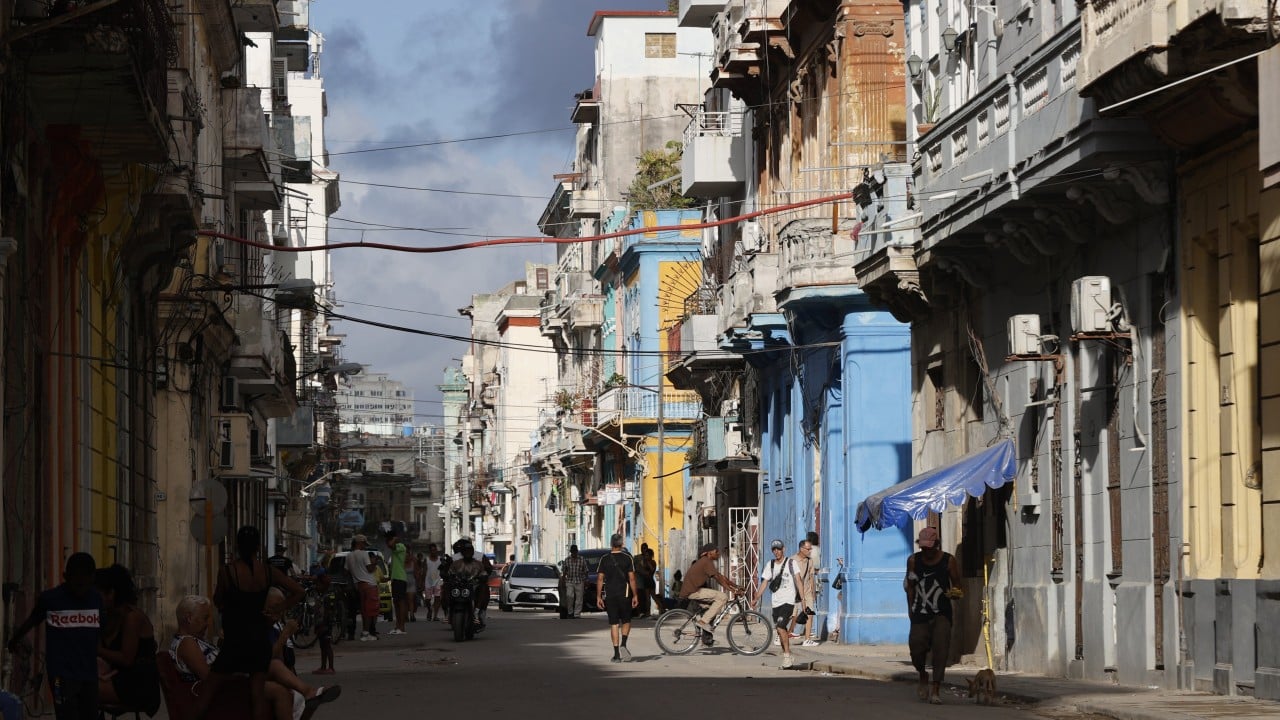
Cuba is currently facing its most severe existential threat since the fall of the Soviet Union. This is not merely a repeat of the "Special Period" of the 1990s; it is a systemic collapse of an aging electrical grid, a crippled currency, and a mass exodus of the island’s youth. While the United States maintains a tightening web of sanctions under the State Sponsor of Terrorism designation, China and Russia are moving in to fill the vacuum. However, their support is not a gesture of socialist brotherhood. It is a calculated, cold-blooded acquisition of strategic real estate 90 miles from Florida.
The island’s power grid recently suffered a total failure, plunging ten million people into darkness for days. This was the breaking point. Washington views the crisis as the inevitable result of sixty years of central planning and authoritarian mismanagement. Havana, meanwhile, points to the embargo as a "genocidal" siege designed to starve the population into revolt. The reality sits in the messy middle: a government that refused to modernize until it was too late, and a U.S. policy that effectively blocks the credit needed to fix the mess.
The Russian Energy Play
Moscow is not sending charity. They are sending oil with strings attached. Vladimir Putin has a long memory and recognizes that Cuba remains the ultimate "unsinkable aircraft carrier" in the Western Hemisphere. After years of relative distance, the Kremlin has returned with a flurry of high-level delegations. The deal is simple. Russia provides the crude oil and wheat that the Cuban state can no longer afford, and in exchange, Russian companies receive preferential land leases and the right to repatriate profits in a way never before allowed under the Castro regime.
This is a fire sale.
The Russian approach involves a fundamental restructuring of the Cuban economy. They aren't interested in keeping the old socialist model alive; they want to convert Cuba into a Caribbean version of the Russian oligarchic system. By advising on "market reforms," Moscow is essentially coaching Havana on how to privatize state assets into the hands of a few loyalists while maintaining strict political control. For Putin, a destabilized Cuba is a lost asset. A stabilized, debt-laden Cuba is a permanent thorn in the side of the United States.
China and the Digital Fortress
If Russia is the muscle providing the fuel, China is the brain providing the infrastructure. Beijing’s interest in Cuba is less about immediate debt repayment and more about long-term surveillance and intelligence. While Chinese state-run media broadcasts messages of "unwavering support" for Cuban sovereignty, the actual investment is focused on telecommunications and port modernization.
Chinese firms like Huawei and ZTE have built the backbone of Cuba’s internet. This gives Beijing a dual advantage. First, it secures a market for its hardware. Second, it provides the Cuban government with the tools to monitor and suppress internal dissent—a skill set that became vital after the July 2021 protests.
There is also the matter of the "listening stations." Reports of Chinese-run electronic intelligence facilities in Cuba have circulated in intelligence circles for years. Even if these reports are dismissed as political posturing in Washington, the logic holds. China’s "Belt and Road" strategy has always prioritized ports that can be converted to dual-use military facilities. The port of Mariel, funded largely by Brazilian capital but now looking for new patrons, is exactly the kind of deep-water prize Beijing covets.
The Failure of the Sanctions Machine
The U.S. policy of "maximum pressure" is currently producing a result diametrically opposed to its intended goal. The logic of sanctions is to make life so difficult that the populace rises up or the government capitulates. In Cuba, the populace is simply leaving. Over 4% of the population has fled to the United States in the last two years alone.
This "safety valve" of migration actually helps the Cuban government. It removes the most frustrated, able-bodied young people who would otherwise be leading protests, and it turns them into a source of future remittances. The Cuban economy now runs on money sent home from Miami. Every time the U.S. tightens the screws, it increases the island's dependence on non-Western actors.
By labeling Cuba a state sponsor of terrorism, the U.S. has made it nearly impossible for European or Canadian banks to facilitate even basic humanitarian transactions. This creates a "compliance chill." When Western banks flee, the state-run banks of Russia and China step in. They don't care about U.S. treasury regulations. They operate in a parallel financial universe that Washington cannot easily touch.
The Myth of Cuban Sovereignty
The tragedy for the Cuban people is that they have become a commodity once again. During the Cold War, they were the front line of the global socialist revolution. Today, they are a distressed asset in a multi-polar bidding war. The Cuban leadership is currently shopping for the best deal to ensure its own survival, and they have found that the authoritarian models of Moscow and Beijing are far more compatible with their interests than the democratic demands of the West.
We are seeing the end of the romanticized Cuban Revolution. What remains is a military-run holding company—GAESA—that controls the tourism, retail, and foreign exchange sectors. This entity is the one negotiating with Russian oil barons and Chinese tech giants. They aren't saving the revolution; they are liquidating it.
The Regional Ripple Effect
The instability in Havana is not contained by the Florida Straits. Venezuela and Nicaragua watch the Cuban crisis with intense anxiety. Cuba provides the ideological and intelligence framework for the "Bolivarian" axis. If the Cuban state truly collapses, the shockwaves will hit Caracas and Managua instantly. This is why we see a coordinated effort from these nations to divert their own meager resources to keep Havana’s lights on.
Mexico and Colombia have also stepped in, though with a different motive. Leaders like Andrés Manuel López Obrador have used Cuba as a tool of domestic signaling, proving their "leftist" credentials by sending ships of fuel. But these are drops in a bucket. Cuba’s energy infrastructure requires billions in capital expenditure, not just a few tankers of diesel.
The Grid is the Ghost
To understand how deep the rot goes, look at the thermoelectric plants. Most are over forty years old. They were built using Soviet technology that is now obsolete. To fix them, Cuba needs parts that aren't manufactured anymore or must be custom-made at a cost the country cannot afford.
The reliance on floating power plants—leased from Turkey—shows the desperation. These ships sit in the harbor and pipe electricity into the grid. It is a temporary, expensive band-aid. When the government runs out of hard currency to pay the Turkish owners, the ships pull up their anchors, and the lights go out.
Russia and China understand that this physical decay is their best leverage. They don't need to fire a shot to take control of Cuba’s future. They just need to wait for the next blackout.
The United States faces a grim choice. It can continue the policy of isolation and watch as its two primary adversaries establish a permanent, high-tech foothold in the Caribbean. Or, it can recalibrate, recognizing that a failed state 90 miles away is a greater national security threat than a communist one. The current path leads to a future where the Cuban people remain trapped between a domestic elite that won't let go and foreign powers that only want to use the island as a pawn.
The auction for Havana is nearly over, and the United States hasn't even placed a bid.



