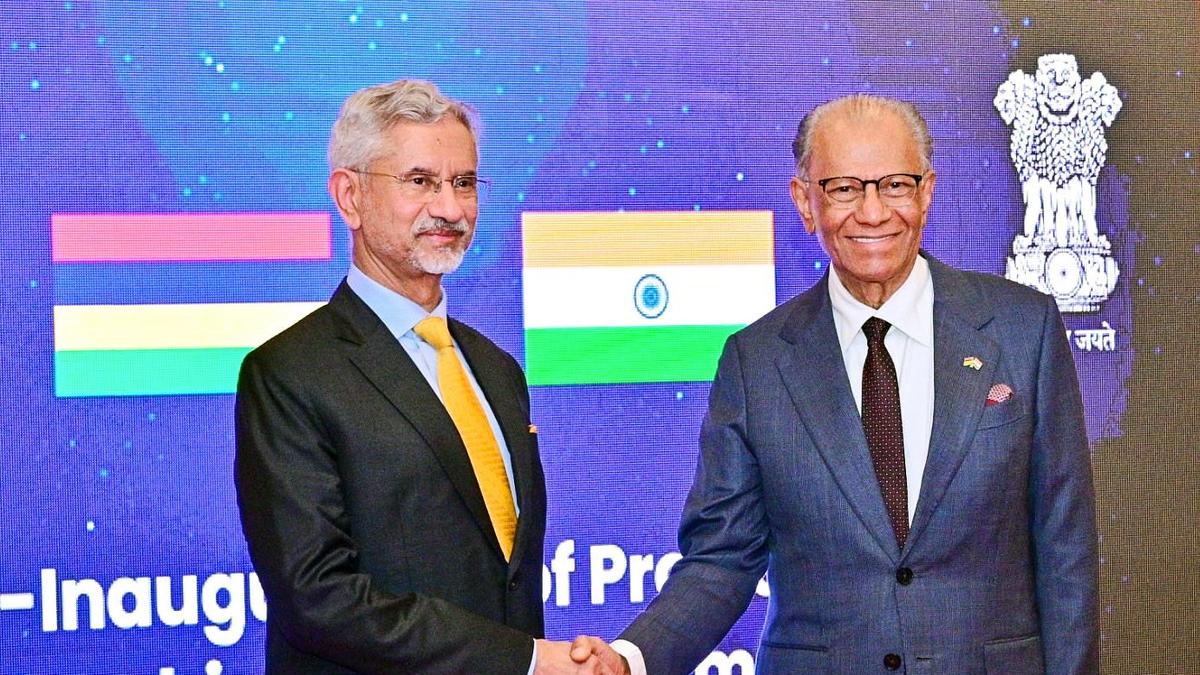
The shift in India’s maritime strategy toward Mauritius represents more than a bilateral trade agreement; it is a calculated de-risking of energy supply chains against the backdrop of West Asian instability. By finalizing an agreement to supply oil and gas directly to Mauritius, New Delhi is transitioning from a passive regional actor to an active guarantor of energy security in the Indian Ocean Region (IOR). This maneuver addresses a critical vulnerability in the Mauritian economy—its near-total dependence on imported refined petroleum—while simultaneously securing India’s "Sagar" (Security and Growth for All in the Region) doctrine through hard infrastructure.
The Triad of Strategic Drivers
The logic underpinning this agreement rests on three mutually reinforcing pillars: energy security, maritime hegemony, and logistics optimization.
1. Risk Mitigation via Supply Chain Diversification
Mauritius historically relies on external markets for its $1.5 billion+ annual energy requirements. In an era where the Bab el-Mandeb and the Strait of Hormuz are subject to kinetic disruptions and soaring insurance premiums, the traditional shipping lanes for hydrocarbons are no longer guaranteed. India’s intervention creates a "Strategic Energy Bridge" that bypasses volatile chokepoints. By sourcing directly from Indian refineries (such as those on the western coast), Mauritius gains a predictable, state-backed supply line that is less sensitive to the price shocks characteristic of the Singapore or Gulf trading hubs.
2. Operational Integration of Refined Products
India has evolved into a global refining powerhouse. Exporting refined products—gasoline, diesel, and aviation turbine fuel (ATF)—to Mauritius allows Indian state-run entities like Indian Oil Corporation Limited (IOCL) to capture the downstream margin that would otherwise be lost to third-party traders. For Mauritius, the benefit is the elimination of the "middleman" tax. This is not a simple commodity sale; it is the integration of Mauritian national demand into the Indian refining schedule, creating a captive market for Indian value-added energy products.
3. Geopolitical Anchoring
Energy is the ultimate "sticky" commodity. Once a nation’s infrastructure—storage tanks, power plants, and bunkering facilities—is calibrated to the specifications and supply cycles of a specific partner, the switching costs become prohibitive. By becoming the primary energy provider, India secures a long-term geopolitical anchor in Mauritius. This relationship facilitates secondary objectives, such as the maintenance of the Agalega airstrip and communication facilities, ensuring that India remains the first responder in the Southwest Indian Ocean.
The Mechanics of the Proposed Agreement
The agreement is expected to move beyond a standard Buyer-Seller contract, likely adopting a Government-to-Government (G2G) framework. This structure provides two essential advantages.
- Price Stability Mechanisms: G2G contracts often involve fixed-premium models or long-term price hedging that protects smaller economies from the daily volatility of the Brent or WTI benchmarks.
- Infrastructure Credit Lines: India is likely to bundle the energy supply with Credit Lines (LoCs) for the expansion of storage capacities in Port Louis. Mauritius currently lacks the "Strategic Petroleum Reserve" (SPR) depth required to weather a prolonged global supply cutoff. Indian technical expertise in building underground rock caverns or massive tank farms will be a prerequisite for this agreement to function at scale.
Quantifying the West Asian Variable
The "West Asia Crisis" mentioned by External Affairs Minister S. Jaishankar is the primary catalyst for the accelerated timeline of this deal. The regional instability creates a two-fold pressure on energy logistics:
- The Tanker Premium: As regional conflict escalates, the "War Risk" insurance for tankers transiting the Red Sea can increase by 500% to 1,000%. By moving supply routes to the South-South corridor (India to Mauritius), these specific risk premiums are largely avoided.
- Displacement of Global Supply: As European and North American buyers scramble to replace Russian or Middle Eastern barrels, smaller island nations like Mauritius are often outbid in the spot market. A formal agreement with India ensures Mauritius is not left to compete on the open market during a global supply crunch.
Technical Bottlenecks and Mitigation Strategies
The success of this energy corridor is not guaranteed and faces several structural challenges that require precise management.
Storage and Throughput Capacity
The current storage infrastructure in Mauritius is designed for high-frequency, low-volume turnover. To act as a regional hub or even to ensure its own domestic stability, Mauritius must drastically increase its "days of cover." The agreement must include a roadmap for the modernization of the Port Louis oil terminal to handle larger vessels (LR1 or LR2 tankers) to achieve economies of scale. Smaller shipments on MR (Medium Range) tankers increase the per-barrel transport cost, potentially neutralizing the benefits of the G2G pricing.
Refining Specification Alignment
Mauritius follows specific environmental standards for fuel (e.g., Euro 4 or Euro 6 equivalent). Indian refineries have already transitioned to BS-VI (Euro 6 equivalent) standards. This alignment reduces the need for "bespoke" refining batches, allowing Mauritius to draw from India's massive domestic surplus without additional processing costs.
The Bunkering Opportunity
A significant byproduct of this agreement is the potential for Mauritius to emerge as a major bunkering (ship refueling) hub in the Indian Ocean. The shipping lanes passing the Cape of Good Hope have seen a 40% to 60% increase in traffic as vessels avoid the Suez Canal due to security threats.
By securing a steady flow of fuel from India, Mauritius can capture the lucrative bunkering market. This transforms the energy agreement from a cost center (importing for domestic use) into a profit center (exporting services to international shipping). India’s role here would be that of an "upstream enabler," providing the raw material that allows Mauritius to monetize its geography.
Strategic Recommendation for Implementation
The transition from a memorandum of understanding to a functional energy bridge requires a three-phase execution:
- Phase I: Hard Infrastructure Parity: Immediate deployment of Indian engineering firms to audit and expand Mauritian storage facilities. Without an increase in physical capacity, the supply agreement remains a "just-in-time" model, which is vulnerable to short-term maritime delays.
- Phase II: Financial De-risking: Establishing a Rupee-Mauritian Rupee trade settlement mechanism for energy. This removes the dependence on US Dollar liquidity, which can be scarce for smaller economies during global financial tightening.
- Phase III: The "Regional Buffer" Concept: Eventually, the India-Mauritius agreement should be expanded to allow Mauritius to hold "Indian-owned" stocks. In this scenario, India stores its own strategic reserves in Mauritian tanks. This provides Mauritius with immediate access to fuel in an emergency while giving India a forward-deployed energy asset in the Southern Hemisphere.
The finalization of this agreement marks the end of "diplomacy by statement" and the beginning of "diplomacy by infrastructure." The movement of hydrocarbons is the most tangible expression of trust between two nations. By underwriting the energy future of Mauritius, India is effectively claiming its role as the central logistical and security pillar of the Indian Ocean. The primary risk remains the speed of infrastructure execution; the geopolitical window created by the West Asian crisis is open now, but it will not remain so indefinitely. The focus must remain on the physical capacity to move and store volume, rather than the mere legalities of the supply contract.