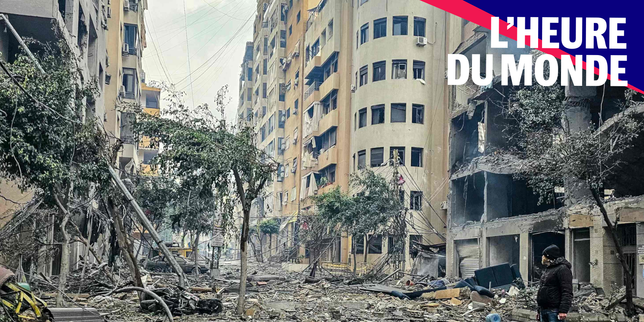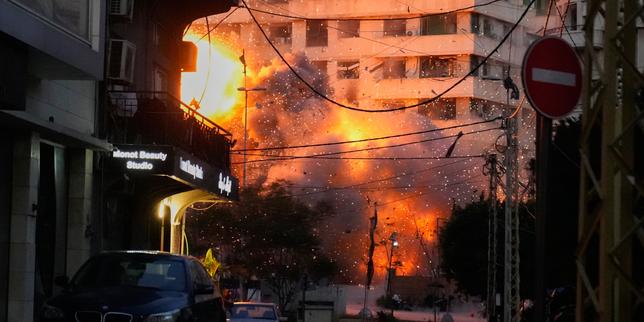
The recent escalation in Beirut and the subsequent retaliatory rhetoric from Tehran represent more than a localized flare-up; they are the measurable outputs of a strained regional security architecture. When the Iranian military leadership vows to "avenge" a political figure like Ali Larijani, the statement functions as a signaling mechanism designed to maintain the credibility of its "Axis of Resistance" while Israeli kinetic operations systematically degrade the command-and-control nodes of that very network. This conflict is currently defined by three structural pressures: the erosion of Hezbollah’s middle-management layer, the diminishing returns of Iranian deterrence, and the shift from "gray zone" warfare to high-intensity urban attrition.
The Attrition of Sub-State Command Structures
The strikes in Beirut, resulting in significant casualties, target the operational heart of Hezbollah’s urban infrastructure. Unlike conventional militaries with rigid hierarchies, Hezbollah operates through a decentralized cellular structure. However, the efficacy of this structure depends on a thin layer of experienced liaison officers and mid-level commanders who bridge the gap between strategic intent and tactical execution.
Israel’s current targeting strategy follows a specific cost-function logic:
- Cognitive Degradation: By eliminating known figures and their immediate subordinates, the IDF forces the organization into a "paranoid" state, where internal communications are slowed by excessive encryption or the total abandonment of electronic tools.
- The Replacement Lag: While foot soldiers are easily recruited, the technical expertise required to operate precision-guided munitions (PGMs) and coordinate multi-vector drone strikes has a high "training-time" cost. You cannot replace a 20-year veteran of logistical coordination in a six-week recruitment cycle.
- Infrastructure Neutralization: Striking Beirut’s dense urban centers serves to sever the physical links between the political wing and the military bunkers, forcing leadership into deeper, more isolated positions that limit their ability to respond to real-time battlefield shifts.
The Larijani Variable and Iranian Credibility
The death of Ali Larijani—or the targeting of figures within his immediate orbit—strikes at the "Strategic Depth" doctrine that has governed Iranian foreign policy for four decades. To Tehran, these individuals are not merely bureaucrats; they are the architects of a non-linear defense perimeter.
The Iranian "Vengeance" cycle operates on a specific logic of proportional signaling. If Iran fails to respond to the elimination of high-value assets, it risks a "cascade of perceived weakness" among its proxies in Yemen, Iraq, and Syria. The difficulty for Tehran lies in the math of escalation. A direct strike from Iranian soil risks a full-scale conventional war for which its air defenses are ill-equipped. Conversely, a weak response via proxies signals to the IDF that the "Red Lines" are porous.
This creates a Deterrence Gap. As Israel increases the frequency and lethality of its strikes in Lebanon and Syria, the cost of Iranian "proportionality" rises. Tehran is forced to choose between strategic patience—which looks like abandonment to its allies—and strategic overreach, which could invite direct strikes on its domestic energy or nuclear infrastructure.
The Mechanics of Urban Attrition in Lebanon
The conflict in Beirut is no longer a border skirmish but a methodical dismantling of an urbanized military apparatus. The complexity of this environment is dictated by the Proximity Variable: the deliberate nesting of military assets within civilian centers to raise the political cost of engagement for the adversary.
Israel’s bypass of this cost involves the use of high-resolution intelligence and low-yield precision munitions designed to collapse specific structures while leaving the surrounding "human shield" infrastructure partially intact—though the six deaths reported indicate the limits of this precision in high-density environments.
From a tactical perspective, the struggle is defined by these variables:
- Sensor-to-Shooter Latency: The speed at which intelligence gathered by drones or signals intercepts is converted into a kinetic strike. In Beirut, this window has shrunk to minutes, leaving Hezbollah’s leadership with almost zero "dwell time" in any single location.
- The Resupply Chokepoint: With the IDF controlling the maritime border and monitoring the Syrian land corridors via aerial dominance, the replenishment of missile stockpiles becomes a logistical impossibility. Every rocket fired is an unreplaceable asset.
- Political Fragility: The Lebanese state is effectively a ghost in this machine. The more the capital is hit, the more the internal Lebanese pressure mounts against Hezbollah. Israel’s strategy includes a psychological component: making the "host" population view the "proxy" as an existential liability rather than a protector.
The Strategic Miscalculation of Symmetric Response
Most analysts view the "vow of vengeance" as a precursor to a specific event (a bombing, a missile salvo). This is a reductive view. Iranian retaliation is more accurately modeled as a Multi-Domain Pressure Campaign.
Instead of a single "big bang," the response often manifests as:
- Asymmetric Maritime Disruption: Targeting commercial shipping in the Gulf or Red Sea, where the Iranian Navy or its Houthi allies have a geographic advantage.
- Cyber Kinetic Integration: Attempting to disrupt Israeli civilian infrastructure (water, power, healthcare) to force a diversion of military resources to domestic defense.
- The "Long Fuse" Assassination: Tracking Israeli or Western officials globally to execute a strike at a time when the immediate heat of the conflict has died down, thereby maintaining the "threat of the unknown."
The limitation of this strategy is that it assumes the adversary is static. Israel has demonstrated a shift toward "Preemptive Decapitation." Rather than waiting for the retaliatory strike, the IDF is accelerating its targeting cycle. This creates a feedback loop where the act of preparing for vengeance triggers a new round of preemptive strikes, further degrading the proxy’s capability before they can even launch.
The Failure of Traditional Diplomacy
The reason diplomatic efforts in Beirut and Cairo consistently fail to produce a lasting ceasefire is due to the Incentive Misalignment between the actors.
- For Israel: The goal is the total removal of the Radwan Force from the border and the destruction of the PGM manufacturing capabilities. A "paper" ceasefire that allows Hezbollah to re-arm is a strategic failure.
- For Hezbollah/Iran: Survival is victory. Any deal that requires them to disarm or retreat significantly from the Litani River is a surrender of the influence they have spent 40 years building.
- For the Lebanese Government: They lack the monopoly on violence required to enforce any treaty, making them a decorative participant rather than a functional one.
This leads to a "War of Position" where both sides are fighting not for a piece of land, but for a specific set of conditions that make the other side’s continued existence untenable.
The Shift Toward "Terminal Degradation"
We are entering a phase where the "Shadow War" has become a "Sunlight War." The ambiguity that previously allowed both sides to save face has evaporated. When the head of the Iranian army speaks of vengeance, he is acknowledging that the previous layers of deniability have been stripped away.
The core bottleneck for the Iranian-led axis is now Technological Asymmetry. The use of AI-driven target acquisition and the integration of multi-spectral sensor arrays have made the "hide-and-seek" tactics of the 2006 Lebanon War obsolete. If a target can be seen, it can be neutralized. The current casualty counts in Beirut are evidence that the IDF is no longer concerned with the "Escalation Ladder." They have opted to jump to the top of the ladder, betting that the internal systemic rot within the Iranian proxy network will prevent a coordinated, effective response.
The strategic play for the coming weeks is the systematic expansion of the target list to include "Enabling Infrastructure"—banks, fuel depots, and transport hubs—that are not overtly military but are essential for the survival of a paramilitary state-within-a-state. The objective is to move from "killing the fighter" to "killing the system."
The Iranian leadership must now decide if they will risk the core—the Iranian state itself—to save the periphery. If the "vengeance" remains verbal or limited to low-impact proxy strikes, the transition of Lebanon into a post-Hezbollah era, however chaotic, becomes the most likely trajectory. The immediate tactical priority for observers is to monitor the movement of Iranian "advisors" in the Damascus-Beirut corridor; their withdrawal or elimination will be the primary indicator of whether Tehran is doubling down or preparing for a managed retreat.