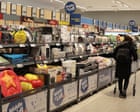
Lidl’s commitment to a £600 million capital expenditure program for the deployment of 50 new UK stores over the next fiscal year represents a calculated intensification of the "Deep Discount" model within a tightening macroeconomic environment. This expansion is not merely a pursuit of market share; it is a defensive and offensive reconfiguration of the grocery supply chain designed to exploit the current delta between consumer inflation and wage growth. The strategy rests on three structural pillars: densification of the physical footprint, the optimization of the logistics-to-shelf ratio, and the weaponization of private-label margins to undercut traditional "Big Four" incumbents.
The Unit Economics of the £12 Million Store Investment
A £600 million investment spread across 50 locations suggests an average all-in cost of £12 million per unit. This figure encompasses site acquisition, construction, fit-out, and initial inventory load. For a discounter like Lidl, the profitability of these new units is contingent upon achieving a specific throughput velocity that offsets the high fixed costs of UK real estate and labor.
The "Lidl Model" operates on a strictly limited Stock Keeping Unit (SKU) count—typically around 2,000 items compared to the 30,000+ found in a traditional supermarket. This concentration of volume into a narrow product range provides two distinct advantages:
- Purchasing Power Parity: By funneling all customer demand into one or two variations of a product (e.g., one brand of canned tomatoes), Lidl achieves a scale of procurement that rivals much larger competitors on an individual item basis.
- Labor Efficiency: Smaller SKU counts reduce the complexity of the "back-to-shelf" process. Every minute spent stocking shelves is a cost center; Lidl’s pallet-ready packaging and high-velocity turnover minimize these touches, allowing for lower staff-to-floor-area ratios.
The £12 million per-store investment must be viewed as a long-term yield play. In the current interest rate environment, the hurdle rate for this capital is higher than it was three years ago. Therefore, these 50 stores are likely strategically positioned in "food deserts" or high-density urban catchments where the competition is either a premium convenience store (high price) or a traditional supermarket (high friction).
Logistics as a Competitive Advantage
The expansion of the storefront is secondary to the expansion of the "Regional Distribution Center" (RDC) network. A grocery store is effectively a temporary storage locker at the end of a very long pipe. If the pipe—the logistics network—is inefficient, the storefront fails.
Lidl’s growth necessitates a corresponding increase in warehouse capacity to maintain the "Just-in-Time" delivery cadence that keeps food fresh while minimizing waste (shrinkage). The capital allocation likely includes significant tranches for automating these RDCs. Automation serves as a hedge against rising UK labor costs and a fluctuating migrant labor pool. By reducing the cost per case handled at the RDC level, Lidl can maintain its price floor even as energy and fuel costs remain volatile.
This creates a self-reinforcing loop:
- Increased store density reduces the "stem mileage" (distance from RDC to store).
- Lower stem mileage reduces fuel consumption and driver hours.
- The resulting savings are reinvested into price-point suppression, further driving footfall.
The Private Label Margin Engine
Lidl’s ability to fund a £600 million expansion during a period of high inflation stems from its mastery of the private-label product mix. Unlike traditional retailers who act as a landlord for national brands (charging "slotting fees" but capturing lower margins), Lidl owns the majority of the brands on its shelves.
The economics of private-label goods allow for a "Double Margin" capture. Lidl controls the manufacturing specifications and the retail price. This eliminates the brand-owner’s profit margin from the cost structure, allowing Lidl to offer a price that is 20-30% lower than national brands while maintaining a healthier net margin for itself.
The expansion into 50 new locations serves as a massive scaling mechanism for these private-label contracts. As the volume increases, the unit cost of production for "Lidl-owned" brands drops, widening the gap between Lidl and any competitor reliant on third-party brand negotiations.
Market Cannibalization vs. Market Penetration
There is a point of diminishing returns in physical retail expansion where a new store begins to steal customers from an existing one. This is known as "cannibalization." Lidl appears to be betting that the UK market is far from this saturation point for the discount segment.
Current data suggests that "basket switching" is at an all-time high. Consumers are no longer loyal to a single grocery brand; they are increasingly "de-averaging" their shopping habits—buying staples at discounters and luxury items at premium retailers. Lidl’s 50-store expansion targets the "middle-ground" retailers (Tesco, Sainsbury’s, Asda, Morrisons). By placing a Lidl store within the 10-minute drive-time radius of a Big Four incumbent, Lidl forces the incumbent to either lower prices (eroding their higher-cost margins) or lose the "weekly shop" volume entirely.
The risk in this strategy lies in the availability of "prime" sites. As Lidl and its primary rival Aldi compete for the same real estate, the cost of acquisition rises. If the price of land in a target borough increases by 15%, the unit economics of the £12 million store are compromised.
The Operational Bottleneck: Labor and Regulation
While the capital for construction is secured, the execution of 50 store openings in 12 months faces two primary external constraints:
- The Labor Tightness: Each new store requires approximately 40-60 employees. Finding and training 2,500 to 3,000 new staff members in a market with low unemployment and rising minimum wages is a significant operational hurdle. Lidl has historically paid above the National Living Wage to ensure retention, but this further pressures the thin margins of the discount model.
- The Planning Permission Lag: The UK planning system remains a primary friction point. A "600 million plan" is subject to local council approvals, environmental impact assessments, and traffic management studies. Any delay in these approvals pushes the Return on Investment (ROI) further into the future, tying up capital that is not yet generating cash flow.
The Defensive Value of the Physical Storefront in a Digital Era
While many retailers have pivoted heavily toward online delivery, Lidl has remained remarkably disciplined in its "brick and mortar" focus. This is a deliberate choice based on the failure of the discount model to translate to home delivery.
The cost of "picking and packing" an online order, combined with the "last-mile" delivery cost, often exceeds the entire profit margin of a discount basket. By forcing the customer to perform the labor of picking and transporting the goods, Lidl preserves its price advantage. The 50 new stores serve as physical nodes that online-only or online-heavy retailers cannot compete with on a pure price-per-calorie basis.
The physical store also serves as a marketing billboard. In a high-inflation environment, the visibility of a Lidl store acts as a constant psychological prompt for "value." This reduces the need for expensive digital marketing and television advertising spend, further lowering the overhead per store.
The Strategic Forecast: A Pivot Toward Sustainability and Data
Lidl’s expansion is the first phase of a broader transformation. Once the physical footprint reaches critical mass, the focus will shift from "Land Grab" to "Efficiency Optimization."
We can anticipate that the next tranche of capital will be directed toward two specific areas:
- Solar and Thermal Integration: Reducing the energy load of massive refrigeration units is the fastest way to lower the "Cost of Goods Sold" (COGS) at the store level.
- Loyalty Data Monetization: The "Lidl Plus" app is transitioning from a simple coupon tool into a data engine. By tracking the exact purchase behavior of millions of UK households, Lidl can begin to optimize its SKU mix with surgical precision, removing underperforming items and further increasing the velocity of its inventory.
The 50-store expansion is not an end goal; it is the construction of a massive, physical data-capture and distribution network. The retailers who will suffer are those who rely on "brand heritage" rather than "infrastructure efficiency." In the next 24 months, the UK grocery market will see a definitive shift where "value" is no longer a niche segment but the dominant market force.
The strategic play for Lidl remains the aggressive conversion of its £600 million capital into physical assets before further inflationary pressures drive up construction and land costs. By locking in these sites now, Lidl is effectively buying future market share at today's prices. Success depends on the rapid scaling of its RDC network to prevent the storefronts from becoming bottlenecks. The firm must prioritize the "time-to-first-sale" for each of these 50 units to ensure the debt-to-equity ratio remains sustainable in a high-rate environment.