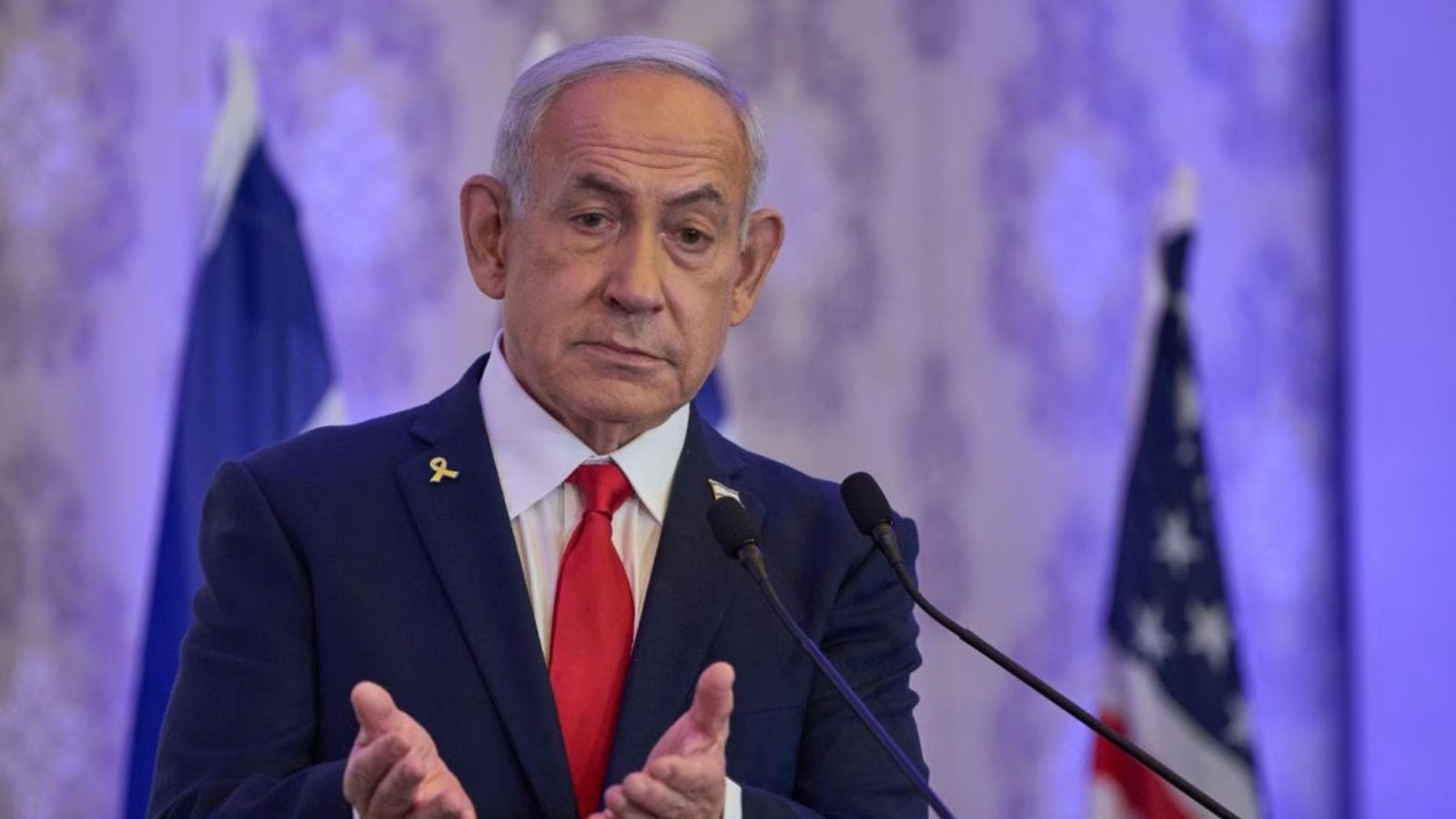
The air inside the podium room at the Kirya—Israel’s military headquarters in Tel Aviv—always feels a few degrees cooler than the humid Mediterranean evening outside. It is a sterile, pressurized environment where the hum of air conditioning competes with the frantic clicking of camera shutters. On this particular night, Benjamin Netanyahu stepped toward the microphones with the gait of a man who has spent decades walking the edge of a knife. He did not look like a leader celebrating a finish line. He looked like a man describing a prologue.
The facts of the evening were stark. Israel had just conducted a series of precise, punishing air strikes against Iranian military targets. It was a direct response to the ballistic missile barrage that had lit up the Israeli sky weeks prior. In the dry language of military briefings, this was "Target Acquisition and Neutralization." But for the millions of people sitting in darkened living rooms from Jerusalem to Tehran, it was something far more visceral. It was the sound of a decades-long "shadow war" finally stepping into the unforgiving light of day.
Netanyahu’s voice was gravelly, steady, and devoid of the celebratory notes one might expect after a successful mission. He spoke of "long-arm" capabilities. He spoke of the "axis of evil." Yet, the most haunting phrase he uttered wasn’t about what had happened, but what hadn't. "The campaign," he noted, "is not over."
Consider a family in a suburb of Isfahan. They are not policymakers. They do not sit in the war rooms. But as the low rumble of Israeli jets echoed over the horizon, the abstract geopolitics of the Middle East became a physical vibration in their floorboards. For them, the "deterrence" discussed in televised speeches is not a strategic concept; it is the terrifying reality of a sky that no longer feels private or safe. This is the human cost of a cycle that has no obvious exit ramp. Every strike is a message, and every message demands an answer.
The strikes focused on the "beating heart" of Iran’s military infrastructure: missile manufacturing facilities and surface-to-air missile arrays. By stripping away these defenses, Israel wasn't just breaking hardware. It was performing a high-stakes surgery intended to leave the Iranian regime feeling exposed. Imagine a fortress where the outer walls have suddenly turned to glass. You are still standing, but everyone can see exactly where you are vulnerable.
This wasn't a blind swing. It was a calculated demonstration of intelligence and reach. For years, the world watched as these two powers fought through proxies—Hamas in Gaza, Hezbollah in Lebanon, the Houthis in Yemen. It was a war of whispers and shadows. But the barrier of deniability has dissolved. When the missiles are launched from sovereign soil to sovereign soil, the rules of the game change. The "proxy" buffer is gone, leaving two regional titans staring at each other across a very short distance.
Netanyahu’s rhetoric served a dual purpose. To his domestic audience, he was the "Mr. Security" they had known for thirty years, asserting that Israel would not be a passive target. To the international community, specifically the United States, he was signaling a disciplined restraint—hitting military assets rather than the oil fields or nuclear sites that could have sent the global economy into a tailspin.
But restraint is a fragile thing. It is a thin thread holding back a tidal wave.
In the corridors of power in Washington, there is a palpable sense of breath-holding. The diplomats speak of "de-escalation," a word that feels increasingly hollow as the batteries of interceptors continue to fire. They want a return to the status quo. But the status quo was a pressure cooker that has already blown its lid. You cannot put the steam back into the pot.
The invisible stakes of this conflict aren't found in the charred remains of a missile factory. They are found in the shifting psyche of an entire generation. In Israel, children grow up knowing the exact number of seconds they have to reach a bomb shelter. In Iran, a young population—many of whom have no love for their aging leadership—finds themselves caught between a repressive regime and the threat of foreign bombs. The trauma is not distributed equally, but it is felt universally.
Wait.
There is a tendency in news reporting to treat these events like a chess match. We analyze the "moves." We debate the "strategy." We treat the leaders like Grandmasters. But in a real chess match, the pawns don't bleed. In the Middle East, the board is made of flesh and bone.
Netanyahu’s address was a reminder that for Israel, this is viewed as an existential marathon. The Israeli perspective is shaped by a historical conviction that weakness is an invitation to catastrophe. If you are hit, you must hit back harder, or the next blow will be fatal. It is a philosophy of "never again" translated into the language of kinetic warfare.
On the other side, the Iranian leadership views its "Strategic Depth"—its network of allies and its missile arsenal—as the only thing preventing a forced regime change. They see themselves as the vanguard of a resistance, fueled by a mixture of religious fervor and cold, hard survivalism. When these two philosophies collide, there is no "middle ground." There is only the temporary silence between explosions.
The Prime Minister’s speech didn't offer a vision for peace. It offered a status report on a struggle that has become the defining feature of his political life. He spoke of the "long-term goal" of dismantling the threats surrounding Israel. It is a goal that requires a constant, grueling effort. It is a war of attrition where the "victory" is simply the privilege of waking up to fight another day.
As the cameras clicked and the reporters scribbled their notes, Netanyahu looked past the lens. He wasn't just talking to the people in the room. He was talking to the leaders in Tehran, telling them that the reach of the Israeli Air Force is longer than their memory. He was talking to his political rivals, asserting his grip on the nation’s defense. And perhaps, in the quietest part of his mind, he was talking to history.
The "Campaign Not Over" isn't a slogan. It is a terrifyingly honest assessment of the state of the world. We are living in an era where the old guards of international order are crumbling, and the new rules are being written in fire.
Think of the silence that followed the address. It wasn't the silence of peace. It was the heavy, pregnant silence of a boxer waiting for the next round to begin. The sweat is still dripping. The heart rate is still elevated. The wounds are being cleaned, but the gloves stay on.
Outside the Kirya, the Tel Aviv night continued. People sat at cafes. They scrolled through their phones, reading the same headlines that were being transmitted across the globe. They looked at the sky, perhaps a little more intently than they did a year ago, wondering if the next light they saw would be a star or a streak of incoming fire.
We often think of history as something that happens in the past. We study the maps of old wars and the speeches of dead leaders. But on nights like this, you can feel history happening in real-time. It is heavy. It is hot. It smells like jet fuel and ozone.
The "long-arm" of the state is a powerful tool, but it is also a heavy one to carry. As Netanyahu stepped away from the podium, the lights stayed on in the war room. The satellites continued their orbit. The pilots stayed on standby. The narrative of the Middle East has always been one of epic proportions, but lately, the scale has become almost too large to comprehend.
It is no longer a localized dispute. It is a fundamental questioning of who gets to define the future of one of the most volatile regions on Earth. The strikes were a comma, not a period. The speech was a breath, not a sigh of relief.
A single red light remained on the camera as the room began to clear. It blinked, a steady, rhythmic pulse in the dimming hall. It looked like a warning light on a dashboard, telling us that the engine is running hot, the road is narrowing, and the destination is nowhere in sight.