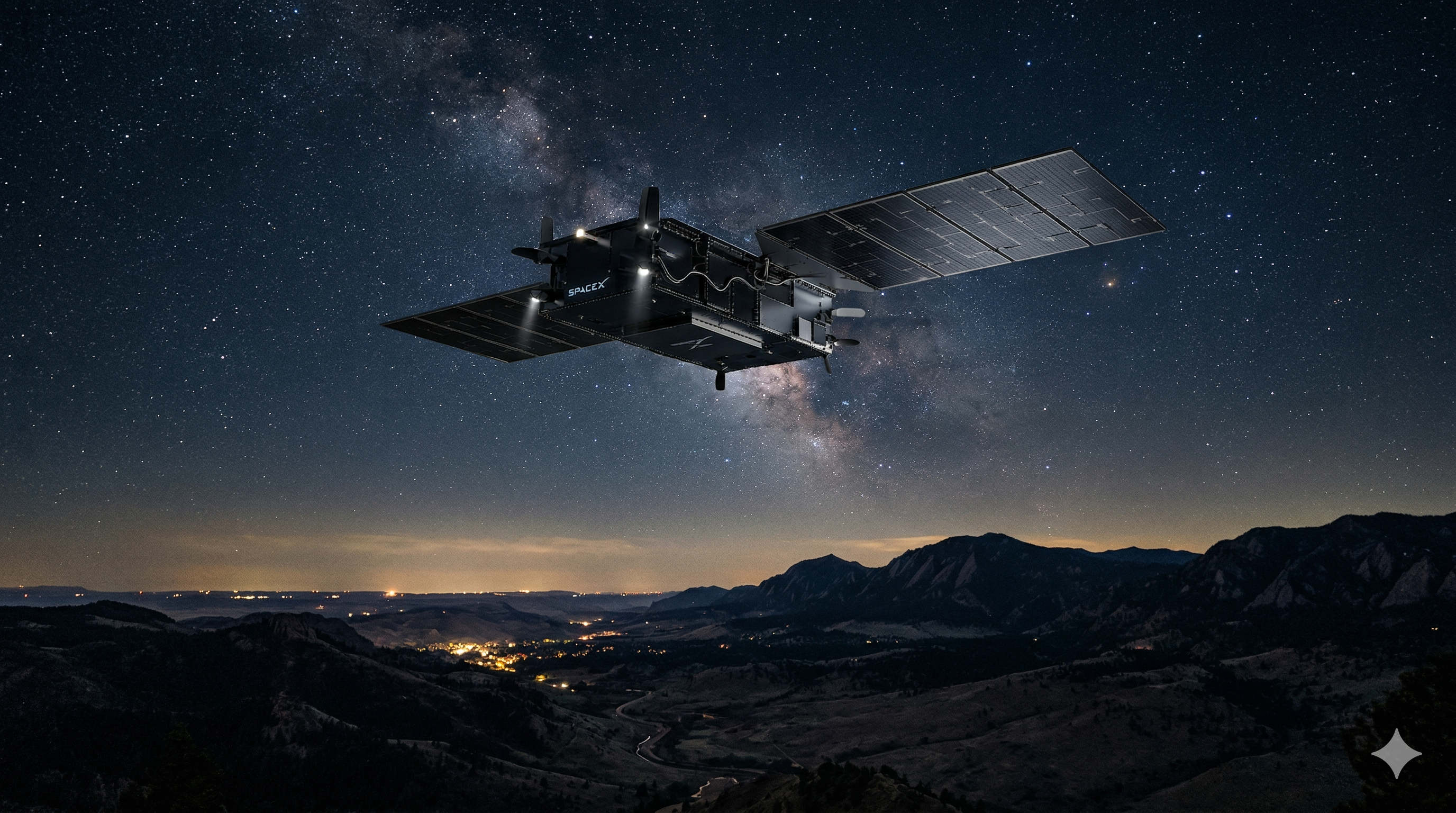
The old man sat on a rickety lawn chair in the high desert of New Mexico, a place where the air usually tastes like dry sage and ancient silence. He had spent forty years waiting for the sun to drop. For him, the day was merely a noisy intermission. The real performance began when the sky bruised into deep indigo and the first pinpricks of light—photons that had traveled for ten thousand years—finally touched the glass of his telescope.
But tonight, the silence was broken by a frantic, rhythmic pulsing.
It wasn’t a heartbeat. It was a parade. Across the velvet expanse of the constellation Orion, a perfectly straight line of brilliant, artificial sparks marched with industrial precision. One after another. A cosmic freight train. These weren't stars. They were SpaceX’s latest fleet, a grid of orbiting mirrors and AI-driven satellites designed to bring high-speed internet to every corner of the globe.
To a silicon valley engineer, that line of light represents a triumph of connectivity. To the man in the lawn chair, it looked like a scar.
The Glass Ceiling in the Sky
For centuries, the sky was the only thing humanity couldn't colonize. We paved the forests, dammed the rivers, and fenced the plains, but the stars remained an infinite, shared heritage. That changed the moment we figured out how to turn the low Earth orbit into a construction site.
We are currently witnessing a gold rush where the "gold" is data latency. Companies are racing to ring the planet with tens of thousands of small satellites. The logic is simple: the closer the satellite is to the ground, the faster your video call loads. But there is a physical cost to this digital speed. These satellites are covered in reflective surfaces. When they catch the sun—even when it’s dark on the ground—they flare with a brightness that rivals the planets.
Astronomers call it "light pollution," but that feels too clinical. It’s more like trying to listen to a whisper in a room where someone is constantly setting off flashbulbs.
When a satellite passes through the field of view of a multi-billion-dollar observatory, it doesn't just leave a small dot. It leaves a wide, glowing streak that can permanently "blind" the sensitive digital sensors. Imagine trying to take a long-exposure photograph of a rare, blooming flower, only for someone to drive a truck with high beams through your garden every thirty seconds. That is the current reality for the Vera C. Rubin Observatory and other massive projects designed to map the secrets of the dark universe.
The Mirror Project and the End of Darkness
If the current satellite swarms are a nuisance, the proposed "orbiting mirror" projects are a manifesto. The concept involves deploying massive, ultra-reflective sheets into space to reflect sunlight down to specific areas on Earth. The stated goal? To provide solar energy at night or to illuminate polar regions.
It sounds like a marvel of geoengineering. It feels like a nightmare for anyone who values the natural rhythm of life.
Consider the circadian rhythm of a migratory bird or the internal compass of a sea turtle hatching on a moonlit beach. These creatures don't have an "off" switch for man-made celestial glare. If we turn the night sky into a giant, flickering billboard for human utility, we aren't just losing a view. We are breaking a biological contract that is billions of years old.
The protest from the scientific community isn't about being "anti-progress." It’s about the arrogance of singular ownership. One company’s decision to launch a mirror project affects every single human eye on the planet. There is no "opting out" of a brightened sky. You cannot close your blinds to the atmosphere.
AI in the Cockpit of the Cosmos
Adding to the complexity is the integration of artificial intelligence within these satellite networks. We are no longer launching "dumb" metal boxes. These are autonomous agents, capable of adjusting their own orbits, dodging space debris, and communicating with each other in real-time to optimize data flow.
This automation is necessary because the sheer volume of traffic is becoming unmanageable for human controllers. There are currently thousands of active satellites; within the decade, there could be 100,000.
At that scale, the sky becomes a crowded freeway managed by algorithms. But algorithms prioritize efficiency, not beauty. They prioritize the signal, not the space between the signals. When an AI-controlled satellite calculates its path, it isn't programmed to care if it ruins a once-in-a-lifetime observation of a distant supernova. It is programmed to ensure a seamless connection for a stock trader in London or a gamer in Seoul.
We are outsourcing the stewardship of our horizon to code that doesn't know how to wonder.
The Invisible Stakes
Why does this matter to someone who isn't an astronomer?
Because the stars are our scale. They are the only thing that reminds us we are small. When we look up and see a chaotic mess of moving lights and artificial glints, the universe starts to feel like just another strip mall. We lose the perspective that comes with staring into the deep, terrifying, beautiful void.
There is a psychological toll to losing the dark. Psychologists have long noted that "awe"—that feeling of being in the presence of something vast—is essential for mental health and social cohesion. It makes us more altruistic and less focused on our individual petty grievances. By cluttering the sky, we are effectively shrinking our world. We are trading the infinite for the immediate.
The data says we need more bandwidth. The soul says we need more silence.
The Collision of Two Futures
We are at a crossroads where two distinct visions of the future are crashing into each other.
In one vision, the Earth is the center of a hyper-connected web. Every square inch of the planet is bathed in signals. No one is ever offline. Information is a universal utility, as common as air. This is a future of incredible equity for education and commerce, but it is a future contained within a glowing, man-made cage.
In the other vision, we recognize that some things are "global commons" that should remain untouched. We decide that the ability to see the Milky Way with the naked eye is as important as the ability to stream a movie in the middle of the Sahara.
The tragedy is that the technology is moving faster than the conversation. By the time we decide the sky is worth saving, it may already be filled with too much "junk" to ever see through again. The debris from a single collision between these AI-managed satellites could create a cloud of shrapnel that stays in orbit for centuries, effectively sealing us inside a shell of our own making.
The Cost of the Connection
The old man in New Mexico packed up his telescope before midnight. The "parade" had passed, but the sky felt different. It felt busy. It felt occupied.
He thought about the kids growing up in cities who have never seen the Great Rift of the Milky Way. Soon, it won't just be the city kids. Even here, in the middle of nowhere, the stars are being outshone by the frantic needs of a world that refuses to sleep.
We are gaining the world, bit by bit, byte by byte. But we are losing the universe.
Every time a new satellite "train" streaks across the sky, a little more of our ancient history is erased. We are the first generation of humans to look up and see our own reflections staring back at us from the stars, mirrored in the polished surfaces of a thousand billion-dollar machines.
The lights are on, but the window is gone.
In our rush to connect everything, we have forgotten how it feels to be connected to nothing but the dark.
The satellites continue their silent, algorithmic dance, blinking with a cold, artificial light that carries no warmth and tells no stories. Below them, the world grows brighter, louder, and smaller, while the true stars—the ones that guided sailors and inspired poets for millennia—slowly fade into the background noise of a planet that no longer knows how to look up.