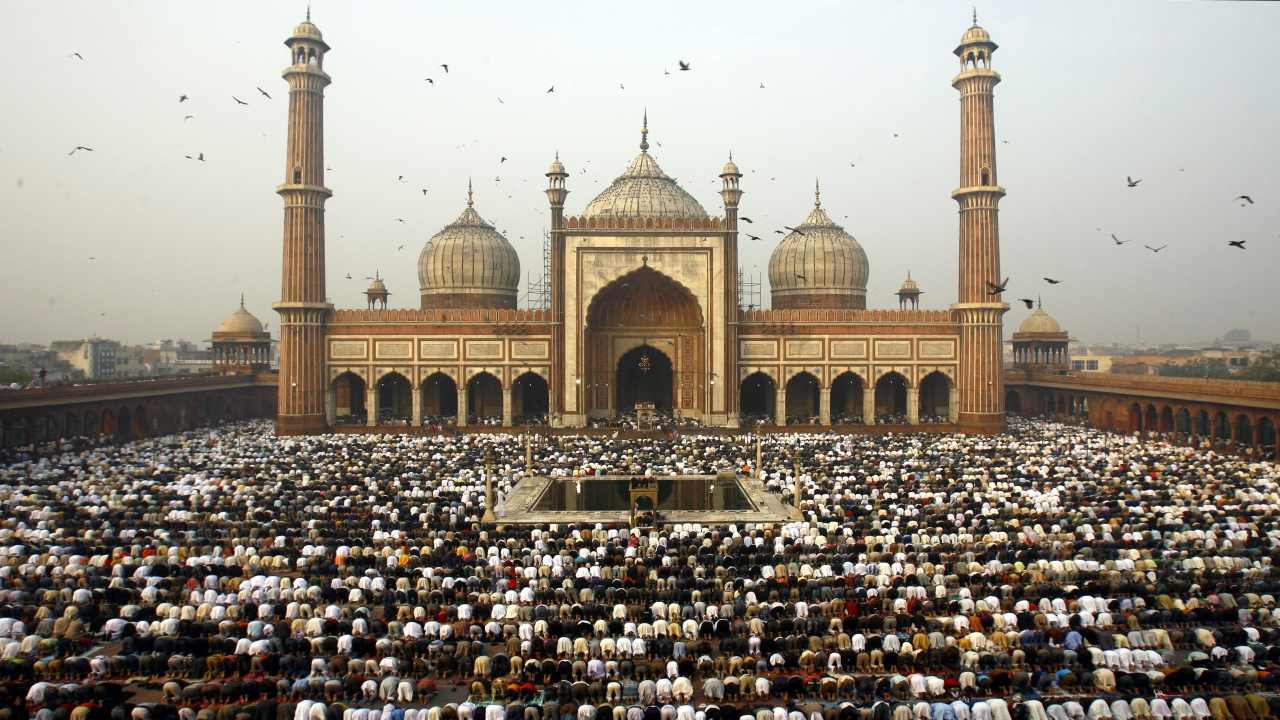
The air in Old Delhi usually smells of parathas and diesel, but tonight, it carries the sharp, electric scent of anticipation. On the rooftop of a cramped apartment building near Jama Masjid, a man named Yusuf adjusts his spectacles. He is seventy-two. His eyes have scanned this specific patch of the horizon for six decades, seeking a sliver of silver no thicker than a human hair. Around him, three generations of his family stand in a hushed semi-circle. His grandson holds a smartphone, its screen glowing with astronomical charts, but Yusuf ignores the digital oracle. He trusts the sky.
This is the ritual of the Ruet-e-Hilal. It is the moment when the abstract calculations of a calendar collide with the physical reality of the cosmos. Across the Indian subcontinent, millions of eyes are doing exactly what Yusuf is doing. They are looking for the Shawwal moon, the celestial signal that thirty days of fasting have come to an end.
But the horizon remains stubborn. A haze of heat and dust hangs over the city, a veil that refuses to lift.
The Weight of a Shadow
To an outsider, the sighting of a moon might seem like a quaint tradition, a charming relic of a pre-digital age. It isn’t. The stakes are deeply personal and logistical. For the devotee, it is the difference between a day of grueling restraint and a day of exuberant feast. For the merchant, it is the difference between a warehouse full of perishable sweets and a sold-out storefront.
The news ripples through the crowd before the official announcement even hits the airwaves. The moon has not been sighted in India.
The silence on the rooftop is heavy. It means that the 29th day of Ramadan will not be followed by Eid-ul-Fitr on the morning of March 20. Instead, the month will complete its full thirty-day cycle. India will celebrate Eid on March 21, 2025.
This delay creates a strange, bifurcated reality in the global neighborhood. While Yusuf and his neighbors prepare for one final day of fasting, the sky has told a different story elsewhere. In Saudi Arabia and the United Arab Emirates, the geographical positioning and the atmospheric clarity allowed for a different outcome. In those regions, the crescent was spotted, marking March 20 as their day of celebration.
This is the paradox of the lunar calendar. One faith, one moon, but two different days of joy depending on where your feet touch the earth.
The Science of the Sliver
Why does the moon play hide-and-seek?
The technicality lies in the "birth" of the new moon. For a crescent to be visible to the naked eye, the moon must have moved a sufficient distance away from the sun. It needs age. It needs altitude. On this particular evening, the moon was technically in the sky over India, but it was too young, too low, and too drowned out by the sun’s lingering afterglow.
Yusuf’s grandson shows him the phone. "The app says it's there, Dada," the boy whispers.
Yusuf smiles, a slow, weathered expression. "Being there is not the same as being seen," he says. "The fast is a lesson in patience. If the moon wants us to wait one more day, we wait. The hunger of the thirtieth day is the most beautiful because you know exactly when it will end."
This extra day—the 30th of Ramadan—is often called the "Bonus Day." It is a day of frantic, last-minute preparations. In the markets of Hyderabad, Lucknow, and Mumbai, the news of the "no-sighting" triggers a second wave of commerce. Tailors who thought they were finished suddenly find themselves with twenty-four more hours to hem a sleeve or finish a set of intricate embroidery.
The Invisible Geography
The divergence between India and the Middle East highlights a fascinating astronomical reality. Because the moon travels from east to west, it "ages" as it moves. By the time the sun sets in Riyadh or Dubai, the moon has had several more hours to move away from the solar glare than it had when the sun set in Delhi or Kolkata.
Those few hours are everything. They are the margin between a sighting and a shadow.
In Saudi Arabia, the Supreme Court confirmed the sighting after observers in various provinces reported the crescent. The UAE followed suit, as did Qatar and Kuwait. For the expatriate families living in those high-rise cities, the feast began with the sunrise on March 20. But for their relatives back in Kerala or Bihar, the kitchen fires stayed dark for one more dawn.
Consider the complexity of a modern family split across these borders. A daughter in Dubai calls her mother in Lucknow. One is frying samosas for a celebration; the other is waking up for Suhoor, the pre-dawn meal. They are separated by a flight of only three hours, but by a lunar decree, they are living in two different months.
The Mercy of the Wait
There is a specific kind of exhaustion that sets in by the 29th day of fasting. The body is light, the mind is sharp but weary, and the soul is sensitive. When the announcement comes that the moon was not seen, there is a collective sigh that isn’t quite disappointment. It is more of a settled resolve.
The final fast of a thirty-day Ramadan feels different than the first twenty-nine. The pressure is off. The countdown has reached its final digit.
In the lanes of the local bazaar, the "Chand Raat" (Night of the Moon) that was supposed to happen tonight has been deferred. The henna artists, who sit on plastic stools with their cones of green paste, look at the sky and then at their customers. They have one more night of work ahead of them. The girls who wanted their palms stained tonight might wait until tomorrow, or they might get it done now, letting the patterns darken for an extra day.
Logic would suggest that a fixed, calculated calendar would be easier. Many modernists argue for it. They point to the confusion, the split dates, and the difficulty of planning office holidays. But for people like Yusuf, the uncertainty is the point.
The moon sighting is a communal act of looking upward. It forces a digital world to pause and acknowledge the cosmic gears. It reminds us that we do not dictate the terms of time; we merely observe them.
The Final Horizon
As the crowd thins on the rooftop, Yusuf lingers. The sky is now a deep, bruised purple. The stars are beginning to puncture the haze.
Tomorrow evening, the moon will be older. It will be higher in the sky, a bold and unmistakable curve of light. There will be no need for spectacles then. The shouting from the streets will announce its arrival before the television news can even process the images.
On March 21, India will wake up to the smell of sheer khurma—dates and vermicelli simmering in sweetened milk. The mosques will overflow with men in crisp, white kurtas. The children will count their Eidi money with sticky fingers.
The delay hasn't taken anything away. If anything, it has sharpened the appetite for the celebration. The moon didn't miss its appointment; it simply asked for a bit more time to prepare for its entrance.
Yusuf folds his spectacles and tucks them into his pocket. He heads downstairs to join his family for one last Ramadan meal. He walks slowly, his footsteps echoing in the stairwell, a man perfectly content to wait for a light that he knows is coming, even if he cannot see it yet.
The horizon is empty, but the heart is full.