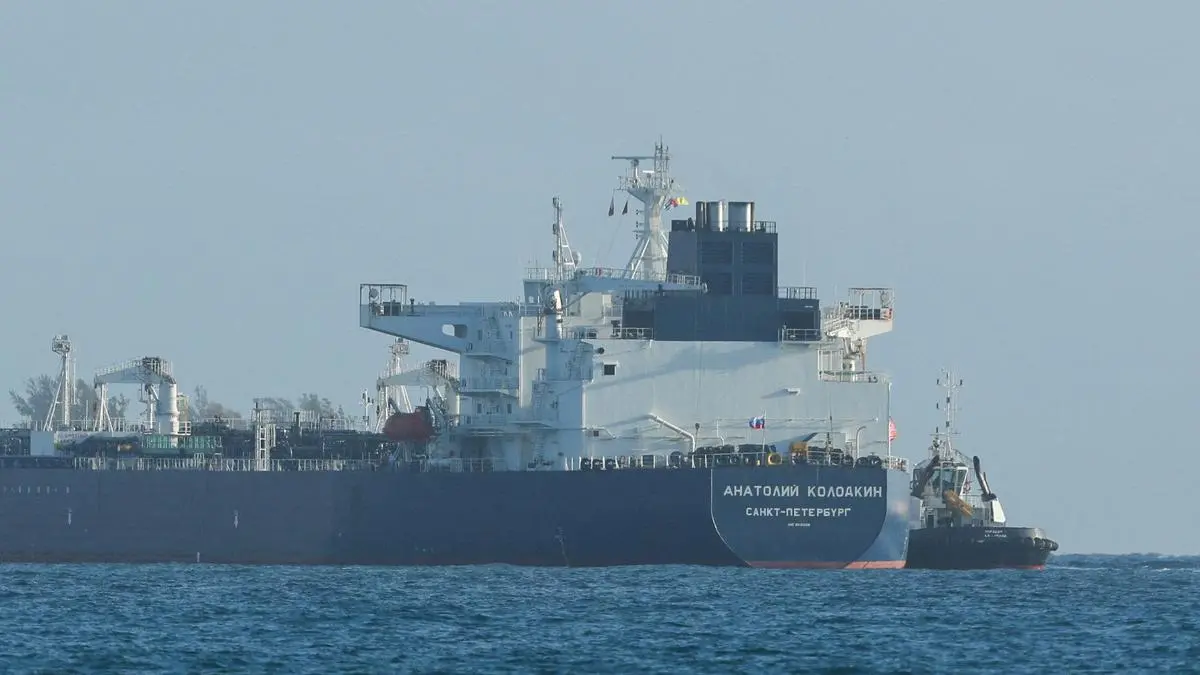
The coffee in the captain's quarters of a Very Large Crude Carrier (VLCC) is always bitter, but tonight, it tasted like ash. Captain Elias—a composite of the men currently gripping radar consoles in the Gulf of Oman—watched the green sweep of the screen. Usually, the Strait of Hormuz is a crowded corridor, a frantic highway of steel and oil. Tonight, the blips were vanishing.
One by one, the icons representing millions of barrels of energy were veering south. They were turning away from the narrow throat of the world.
The Strait of Hormuz is a geographic fluke that dictates the pulse of global civilization. It is only twenty-one miles wide at its narrowest point. Through this slender gap flows roughly one-fifth of the world’s total oil consumption. When a blockade looms, or when the United States signals a hard line that might choke this artery, the world doesn’t just watch the news. The world holds its breath.
Steel and salt. That is the reality of global energy. We speak about oil in terms of futures, benchmarks, and geopolitical leverage, but at the water's edge, it is about 300,000-ton vessels trying to decide if a cargo worth $100 million is worth the risk of a missile or a seizure.
The Ghost Fleet
In the shipping offices of Singapore and London, the atmosphere is surgical. Traders stare at "dark" ships—vessels that have turned off their Automatic Identification Systems (AIS) to slip through contested waters unnoticed. But as the threat of a formal U.S. blockade intensifies, even the shadows are staying home.
Modern tankers are marvels of engineering, but they are also incredibly vulnerable targets. A VLCC can be over 1,000 feet long. It takes miles to stop and even longer to turn. In the tight confines of the Strait, surrounded by jagged coastlines and unpredictable naval patrols, these giants are sitting ducks. Insurance premiums for these voyages have begun to skyrocket, sometimes leaping by tens of thousands of dollars in a single afternoon.
Economics is often described as a cold science. It isn't. It is a fever.
When the news of a blockade breaks, the first reaction is a frantic calculation of risk. The second is a physical withdrawal. Shipping companies aren't just protecting oil; they are protecting the lives of the twenty-five souls on board and the integrity of hulls that, if breached, could cause environmental catastrophes that last generations. So, they wait. They anchor in the deep water of the Arabian Sea, drifting in circles, waiting for a signal that may never come.
The Invisible Pressure
Think of the global energy supply like a massive, pressurized plumbing system. The Strait of Hormuz is the primary valve. If you close that valve, the pressure doesn't just disappear; it backs up into every corner of the house.
A blockade isn't just a row of warships. It is a psychological wall. The mere threat of U.S. intervention acts as a physical barrier. For a captain like Elias, the "blockade" begins the moment his company’s legal department sends an encrypted message advising "extreme caution." It begins when the hull insurance is revoked for specific coordinates.
The logic of a blockade is simple and brutal: stop the flow, starve the adversary. But the unintended consequences ripple outward like a stone thrown into a still pond.
- Supply Chains: Refineries in South Korea and India are calibrated for specific grades of crude that come almost exclusively from the Gulf. When those tankers steer clear, those refineries must slow down.
- Price Shocks: The cost of "delivered" oil includes the risk. If a ship has to take the long way around or wait out a political storm, you feel it at a gas station in Ohio or a logistics hub in Berlin.
- The Human Cost: We forget the merchant mariners. These are people who spend months away from home, now tasked with navigating a geopolitical chessboard where they are the pawns.
The tension is a physical weight. On the bridge of a tanker, every fishing dhow looks like a scout. Every drone on the horizon is a potential threat. The silence of a diverted fleet is louder than the roar of their engines.
A Geography of Fear
The Strait is a place where ancient history meets 21st-century weaponry. On one side, the rugged Musandam Peninsula of Oman; on the other, the long, winding coast of Iran. Between them, a shipping lane only two miles wide in each direction.
If the U.S. moves to implement a blockade—effectively stopping Iranian exports or securing the passage against hostile interference—the physics of the region change. It becomes a game of chicken played with billion-dollar assets.
Consider the sheer scale of the cargo. A single large tanker carries enough oil to keep a major city running for days. When dozens of these ships decide to "steer clear," we are looking at a massive disconnection of the global nervous system. We have spent decades building a "just-in-time" economy. We rely on the fact that the oil will always be there, moving silently across the blue.
We are not prepared for the silence.
The data confirms the shift. Satellite imagery shows a thinning of the herd. The "heat maps" of maritime traffic, usually a solid red line through the Strait, are fading to a pale orange. The ships are clustering outside the danger zone, huddling together like cattle before a storm.
This isn't just about politics. It’s about the fundamental fragility of our modern lives. We live in a world built on the assumption of open seas. When those seas close, the walls of our own world start to feel much closer.
The Price of Empty Horizons
What happens when the tankers don't come back?
It isn't a sudden collapse. It's a slow grinding of gears. First, the "spot price" of oil jumps as traders panic. Then, the shipping routes get longer as companies seek alternatives, burning more fuel just to deliver fuel. Finally, the political pressure becomes unbearable.
But the real story isn't in the spreadsheets. It’s in the dark bridge of a tanker drifting five hundred miles off the coast. It’s in the eyes of a captain who knows that his ship is a target, his cargo is a prize, and his route is a ghost story.
The U.S. blockade is a word used in press briefings and think-tank papers. On the water, it is a wall of invisible glass. You can see the destination, but you know that if you touch it, everything shatters.
Elias stepped out onto the wing of the bridge. The air was thick with humidity and the smell of salt. Somewhere to the north, the most important waterway in the world was turning into a vacuum. He looked at his watch. He looked at the empty horizon. He gave the order to maintain their southward heading.
The world would have to wait. The oil would stay in the tanks. The sea, for the first time in a generation, was becoming a wilderness again.
Beyond the politics and the power plays, there is only the water, the wind, and the terrifying realization of how much we rely on a few miles of ocean that we no longer control.