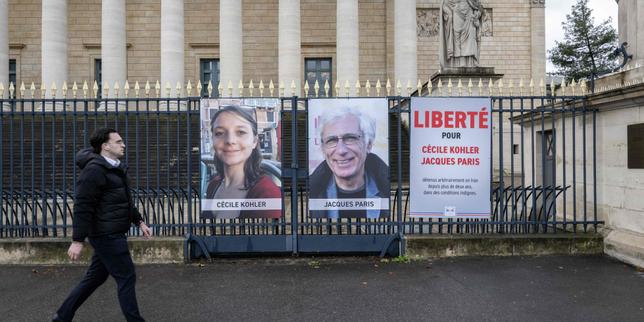
The release of Cécile Kohler and Jacques Paris from Iranian custody functions as a case study in the high-stakes intersection of geopolitical leverage and psychological endurance. To understand their trajectory—from the isolation of Section 209 to their eventual transport across Iranian territory—requires moving beyond the emotional narrative to examine the structural logic of state-sponsored detention. This process operates under a specific framework of "asymmetric diplomatic currency," where individual lives are converted into negotiable assets.
The Architecture of Section 209: Psychological Degradation as a Control Variable
Evin Prison's Section 209 is not merely a place of confinement; it is a specialized environment designed for sensory deprivation and cognitive disorientation. Controlled by the Ministry of Intelligence (MOIS), its operations follow a predictable sequence of psychological stressors meant to break the captive’s sense of time and self.
- Environmental Isolation: Cells are typically small, windowless, and kept under 24-hour artificial lighting. This disrupts the circadian rhythm, a primary biological anchor for cognitive stability.
- The Interrogation Loop: Unlike criminal investigations aimed at discovering facts, these sessions focus on "narrative alignment." The goal is to force the detainee to adopt a pre-written confession that fits a specific geopolitical objective.
- Total Informational Asymmetry: Guards and interrogators control all external data. This creates a dependency where the captor becomes the only source of "reality," a tactic designed to induce learned helplessness.
For Kohler and Paris, surviving this phase required a rigorous internal compartmentalization. The mechanism of survival in such high-density stress environments relies on maintaining "micro-autonomy"—the ability to control small, seemingly insignificant aspects of daily life, such as a physical exercise routine or a mental inventory of memories, to resist the erosion of the ego.
The Logistics of the Hostage Asset Lifecycle
The detention of foreign nationals in Iran follows a specific lifecycle that transitions from "Acquisition" to "Calibration" and finally "Liquidation" (Release).
1. Acquisition and Charge Framing
Detentions often occur during periods of domestic unrest or when external diplomatic pressure peaks. The choice of Kohler and Paris, union activists, provided the Iranian state with a specific narrative tool: the accusation of "fomenting labor unrest" on behalf of foreign intelligence services. This framing serves a dual purpose: it justifies the arrest to a domestic audience and sets a high "buy-back" price for the home country.
2. Calibration of Leverage
During the middle phase of detention, the "asset" is calibrated based on the responses of the home government. France’s strategy in this instance involved a combination of "discreet diplomacy" and public pressure. The duration of the detention—nearly three years—indicates a protracted negotiation over specific concessions, which often include the release of frozen assets, the exchange of Iranian operatives held abroad, or shifts in regional policy.
3. The Liquidation Phase: The Mechanics of the "Long Drive"
The physical transfer of Kohler and Paris from Tehran to the border is a distinct operational phase. The decision to transport them by car across the country, rather than a direct flight from the capital, serves several tactical functions:
- Operational Security (OPSEC): Ground transport allows the security apparatus to move targets through controlled corridors without the visibility of international flight tracking or airport surveillance.
- Psychological Transitioning: The long transit serves as a "de-escalation" period. Moving from a cell to a vehicle begins the process of re-sensitizing the captive to the outside world, ensuring they are in a manageable state when handed over to intermediary officials.
The Role of Intermediary States in the Extraction Corridor
The release was facilitated through Oman, which acts as the primary "clearinghouse" for Western-Iranian hostage swaps. This role is built on a foundation of "neutrality-as-a-service."
The logistical chain functions as follows:
- Agreement Finalization: Once the diplomatic deal is struck, the captives are moved to a secondary site, often under the guise of another interrogation or transfer.
- Verification of Identity: Intermediaries (often Omani officials or designated third-party diplomats) verify the physical and mental health of the assets.
- Physical Extraction: The hand-off usually occurs at a secondary airport or a border crossing, away from the immediate glare of the global press, allowing both states to claim a "humanitarian" victory without admitting to a transactional swap.
Analyzing the "Price" of the Release
The cost of recovering Kohler and Paris is rarely public, but the geopolitical ledger provides clues. In the months leading up to their release, various levers were likely adjusted. These include the status of Iranian prisoners in Europe and the fluidity of financial sanctions.
The primary risk in these transactions is "incentive alignment." Each successful swap reinforces the utility of the "Hostage Diplomacy" model. From a strategic consulting perspective, the French government faced a "Sunk Cost Fallacy" trap: the longer the detention lasted, the more pressure built to pay an increasingly higher price for their release.
The Structural Fragility of Professional Travel in High-Risk Jurisdictions
The Kohler-Paris case highlights a critical failure in risk assessment for individuals traveling in dual-use capacities (e.g., activists, academics, or NGO workers). The "Risk-Reward Matrix" for such travel is often skewed by an underestimation of state-level predatory behavior.
- The "Target Profile" Variable: Being associated with organized labor or civil society groups increases a traveler's "Value Density" to a state looking for leverage.
- The "Political Climate" Variable: Individual safety is tied directly to macro-level diplomatic tensions. When a state like France takes a hard line on nuclear proliferation or regional proxy conflicts, the risk to its citizens in Iran increases exponentially, regardless of their personal actions.
Survival and eventual extraction depend entirely on the home state's ability to maintain a credible "threat-and-reward" balance. The release of Kohler and Paris does not signal a softening of Iranian policy, but rather a successful "clearing of the books" for this specific set of assets.
The Logic of Post-Release Recovery and Intelligence Debriefing
Upon landing on French soil, the process transitions from physical extraction to "Intellectual Salvage." The French DGSE (General Directorate for External Security) would immediately initiate a debriefing protocol. This is not just about the health of the survivors, but about gathering data on:
- Interrogation Methods: Identifying new techniques or specific personnel within Section 209.
- Structural Layouts: Mapping the physical changes within the prison system.
- Internal Factions: Assessing the behavior of guards and officials to gauge internal power shifts within the Iranian intelligence apparatus.
The survivors must navigate a "Recompression Phase." After years of total control, the sudden influx of autonomy can be psychologically overwhelming. Professional reintegration requires a slow-release of responsibility and specialized trauma care focused on "Restorative Agency"—rebuilding the capacity to make decisions without the looming threat of state sanction.
The strategic play for European governments moving forward must involve a fundamental shift in the "Travel Advisory" framework. The current system relies on passive warnings. A more robust strategy would involve "Active Deterrence"—implementing immediate, pre-defined sanctions the moment a citizen is categorized as "arbitrarily detained." This would shift the cost-benefit analysis for the detaining state, potentially making the acquisition of such assets more expensive than the diplomatic currency they generate. Without this shift, the cycle of detention and extraction remains a predictable, albeit brutal, tool of international relations.