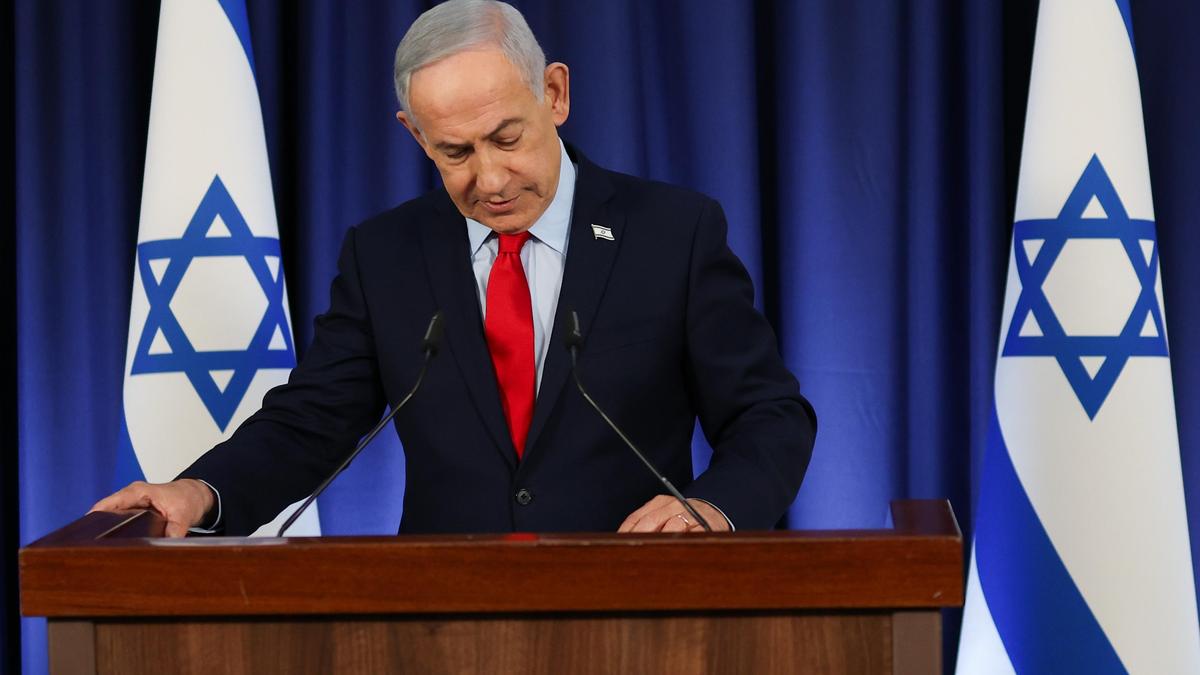
The intersection of historical analogy and modern diplomacy often creates high-velocity friction when political leaders utilize religious figures as rhetorical variables. When Israeli Prime Minister Benjamin Netanyahu faced allegations of denigrating Jesus by comparing him to Genghis Khan, the resulting controversy was not merely a linguistic misunderstanding. It was a breakdown in the strategic management of cultural sensitivities. In a geopolitical environment where religious alignment dictates the strength of international coalitions, the precision of historical analogy serves as a primary asset or a catastrophic liability.
The Architecture of the Controversy
The friction point originated from a reported private conversation or internal meeting where historical figures were allegedly used as benchmarks for leadership or historical impact. To analyze this effectively, we must categorize the event into three distinct analytical pillars:
- The Rhetorical Objective: The intended utility of the analogy.
- The Theological Constraint: The boundaries of acceptable discourse regarding religious icons.
- The Diplomatic Feedback Loop: The mechanism by which internal comments become international incidents.
Netanyahu’s denial focuses on the distortion of his words, asserting that the comparison was never intended to diminish the religious significance of Jesus but rather to contextualize historical influence. However, in the realm of high-stakes diplomacy, intent is often secondary to perception. The comparison of a central figure of Western faith to a conqueror associated with mass destruction like Genghis Khan creates a cognitive dissonance that triggers immediate defensive postures from strategic allies.
The Framework of Historical Analogy
Leaders utilize historical parallels to simplify complex current events. This is a common heuristic in political communication. To understand why this specific analogy failed, we must look at the Semantic Utility Function.
A successful analogy requires a shared understanding of the variables.
- Variable A (Jesus): Represents spiritual authority, peace, and the foundation of Western ethics for a multi-billion person demographic.
- Variable B (Genghis Khan): Represents military efficiency, the expansion of the Mongol Empire, and a legacy of extreme violence.
When these two variables are placed in the same equation—regardless of the connective tissue of the sentence—the brain of the listener performs a "property transfer." The negative attributes of Khan (violence, paganism, conquest) are mapped onto Jesus, or vice versa, leading to what cognitive scientists call Analogical Mapping Error. For Netanyahu, whose political survival often depends on the support of Evangelical Christians in the United States and elsewhere, this mapping error carries a high political cost.
The Cost Function of Rhetorical Imprecision
Political capital is a finite resource. Every communication act either deposits into or withdraws from this account. The denial issued by the Prime Minister’s Office is an attempt to mitigate a "Bank Run" on political capital from his Christian Zionist base.
1. Alliance Fragility
The relationship between the Israeli right-wing and global Christian organizations is built on a foundation of shared biblical reverence. When a leader is perceived as mocking or minimizing the central figure of that faith, the alliance undergoes a stress test. The cost here is measured in the loss of lobbying power and grassroots support in key Western jurisdictions.
2. Narrative Asymmetry
In the digital information ecosystem, a denial rarely travels as fast as the initial accusation. The "Genghis Khan" headline creates a lasting mental anchor. Even if the denial is factually accurate, the association remains. This creates a bottleneck in future communications where Netanyahu must spend more energy on "damage control" than on proactive policy promotion.
Analyzing the Mechanism of the Denial
Netanyahu’s denial was structured as a "Refutation of Intent." This strategy relies on the premise that the speaker’s internal motivation overrides the audience’s interpretation. From a strategic consulting perspective, this is a weak defense.
A more robust defense would have been the Contextual Re-anchoring Technique. Instead of simply saying "I didn't say that," a leader clarifies the specific metric being compared. If the comparison was regarding "historical figures who changed the course of the world," the focus should have stayed strictly on the metric of historical velocity rather than the character of the individuals.
The failure to define the metric of comparison allowed the media to fill the vacuum with the most inflammatory interpretation possible.
Geopolitical Implications of Theological Friction
The Middle East operates on a grid of religious sensitivities. For Israel, maintaining the "Special Relationship" with the United States involves navigating the complexities of the American religious landscape.
The demographic shift within the U.S. means that younger generations are already more skeptical of unconditional support for Israel. When headlines surface suggesting the Israeli leadership is dismissive of Christian figures, it provides rhetorical ammunition to those advocating for a pivot in foreign policy. The "Genghis Khan" incident, while seemingly a minor gaffe, feeds into a broader narrative of Israeli exceptionalism that can alienate moderate religious blocs.
The Feedback Loop of Internal vs. External Discourse
This event highlights the "Two-Front Communication Problem" faced by many world leaders:
- Internal Front: Using blunt, sometimes hyperbolic language to satisfy a domestic base or a small circle of advisors.
- External Front: Maintaining a polished, culturally sensitive persona for the global stage.
The leak of the Genghis Khan comment suggests a breach in the firewall between these two fronts. When internal rhetoric leaks into the external sphere, the translation is almost always lossy and detrimental.
The Strategic Shift Toward Precision
To avoid such friction in the future, the Prime Minister’s communication apparatus must adopt a Pre-emptive Sensitivity Filter. This involves vetting analogies not just for historical accuracy, but for "Theological Impact Potential."
If a historical figure is being used to illustrate a point, the team must ask:
- Does this figure hold sacred status for a key demographic?
- Does the comparison partner carry heavy negative externalities (e.g., mass violence, anti-democratic values)?
- Is the metric of comparison (influence, power, longevity) clearly defined within the speech?
By failing these three tests, the Genghis Khan comparison became a self-inflicted wound. The denial serves only to stop the bleeding, not to heal the underlying reputational scar.
In an era of deep-fake audio and highly polarized media, the margin for error in leadership rhetoric has narrowed to near zero. A leader's words are no longer fleeting sounds in a room; they are data points in a global sentiment analysis engine. Netanyahu's denial is a tactical necessity, but the original rhetorical choice represents a strategic failure in understanding the modern information environment.
Future diplomatic engagement requires a rigorous adherence to verbal discipline. The play here is not to litigate what was said in the past, but to establish a new protocol of "Rhetorical De-escalation." This means avoiding religious figures entirely in secular political comparisons and focusing on non-polarized historical precedents. The cost of a "colorful" analogy is simply too high for the return it provides. The focus must remain on the mechanics of statecraft, leaving the interpretation of religious figures to the theologians, thereby insulating the political alliance from unnecessary volatility.
Monitor the sentiment of Evangelical polling over the next fiscal quarter to determine if the denial successfully recalibrated the base, or if a more significant symbolic gesture of religious alignment is required to offset the narrative debt incurred.