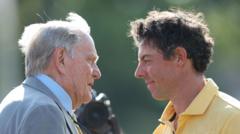
The golf media is currently busy polishing the shoes of Rory McIlroy, declaring him the newest member of the "All-Time Greats" after his second consecutive Masters win. They are running the numbers, comparing his six majors to Faldo, and salivating over the "Career Grand Slam."
They are dead wrong.
Stop trying to force McIlroy into a box he doesn't fit. When you label him an "All-Time Great," you are judging him by the standards of a bygone era. You are using an outdated metric—raw major count—to evaluate a golfer who functions in a reality entirely divorced from the robotic consistency of Jack Nicklaus or the suffocating dominance of prime Tiger Woods.
McIlroy isn't an "all-time great" in the sense that he is the most reliable machine to ever step onto a tee box. He is something far more dangerous and far more rare: the most volatile elite athlete the sport has ever seen.
The Myth of Statistical Greatness
The obsession with major championship totals is a trap. It assumes that every decade of professional golf is comparable. It isn't. I have seen countless pundits track the "major gap" as if the strength of the field, the technological advancement of equipment, and the sheer depth of professional talent have remained stagnant for fifty years.
They haven't.
If you compare McIlroy to the icons of the 1970s or 1990s, you are ignoring the statistical density of the current field. Today, the difference between the world number one and the world number fifty is a margin of error, not a chasm. When Nicklaus was winning, he was beating a handful of guys who practiced once a week and spent the rest of their time selling insurance. When McIlroy wins today, he is navigating a field where every single player has a team of biomechanists, data analysts, and a swing speed that would have been considered superhuman two decades ago.
McIlroy winning six majors in this era is arguably more difficult than winning ten in the era of limited field depth. But the casual observers don't want to hear that. They want a simple list. They want to put him in a spreadsheet.
Why The Label Holds Him Back
By clinging to the "Greatest Of All Time" narrative, you are trivializing the complexity of McIlroy's career arc.
Consider his mid-career "drought." For years, critics mocked his inability to close majors. They analyzed his mental state, his swing, his equipment, his personal life. They wanted him to be Tiger. They wanted him to be a cold-blooded assassin who never made a mistake.
When he finally broke through at the 2025 Masters, the narrative shifted instantly: "He's back." But he never left. He simply stopped trying to play the game in a way that didn't suit his nervous system.
McIlroy is an emotional, reactive player. When he is "on," he is unplayable—the most aesthetically pleasing and physically gifted ball-striker in history. When he is "off," the wheels come off in spectacular, public, and often humiliating fashion. That isn't a flaw; it is a feature.
Imagine a scenario where we stop asking if McIlroy is "the best" and start asking why we are so terrified of inconsistency. The sports media demands a narrative of linear progression. Athlete trains. Athlete succeeds. Athlete repeats.
McIlroy rejects that. His career looks like a seismograph during a major earthquake. He is the only player who can shoot a 62 one day and a 78 the next, not because of a technical failure, but because he is feeling the weight of the air differently.
The Real Lesson Is Being Ignored
If you want to understand why Rory McIlroy is actually superior to his predecessors, look at the last two years. He didn't win these Masters titles by becoming a robot. He won them by embracing the chaos.
He didn't iron out his mistakes. He learned to scramble better than anyone on the planet. He stopped trying to be the guy who hits 18 greens in regulation and accepted that he would have to save par from the woods, from behind grandstands, and from the deep rough. That is the mark of a modern master.
The old greats played "perfect" golf because the courses allowed for it. Today’s courses are designed to break the player. McIlroy has learned to play break-resistant golf.
Stop looking for another Tiger Woods. Stop looking for the next Jack Nicklaus. Those players are dead, in a sporting sense. The world has changed. The equipment has changed. The psychology of the game has shifted from "mastery of the swing" to "mastery of the outcome."
Rory McIlroy isn't the greatest of all time. He is the first of a new breed: the high-variance champion. He is proof that you don't need to be perfect to conquer the modern game. You just need to be more resilient than the guy in the group ahead of you.
The industry will keep trying to categorize him into the past. Let them. While they are busy debating his rank in some imaginary pantheon, he will keep showing up, making a mess of the first three days, and finding a way to win on Sunday.
That is not greatness. That is something far more interesting.
Stop checking the record books. Start watching the man.