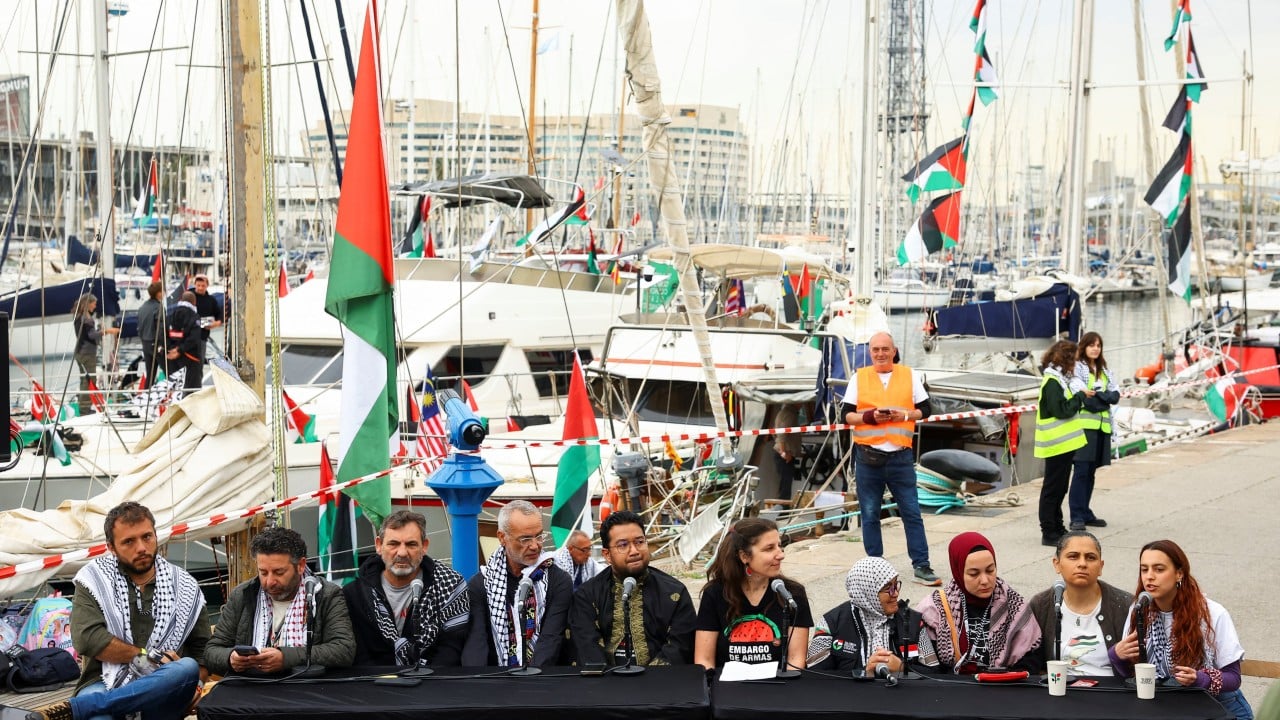
The Mediterranean does not care about politics. It is a vast, indifferent blue that swallows secrets and anchors alike. But for the men and women standing on the docks of southern Spain this week, the water felt like a wall. A wall that needed to be climbed.
The Sumud aid flotilla did not slip away in the middle of the night. It departed with the heavy, metallic clang of intent. These are not warships. They are aging vessels, repainted and repurposed, carrying something far heavier than their manifest of medical supplies and food: they carry the weight of a conscience that refuses to look away.
The Weight of a Name
Sumud. It is an Arabic word that doesn't translate neatly into English. It is more than "steadfastness." It is the act of staying put when the world is trying to blow you away. It is the stubbornness of an olive tree clinging to a dry hillside. By naming the flotilla Sumud, the organizers—a coalition of international activists—transformed these boats into floating metaphors.
They are sailing toward Gaza. They are sailing toward a blockade that has turned a strip of land into a pressurized chamber of human suffering. To understand why someone would leave the safety of a Spanish harbor to face the Israeli navy, you have to stop thinking about "aid" as a spreadsheet of calories and bandages.
Think instead of a mother in Gaza trying to bake bread.
She has no yeast. The flour is gray and gritty. The water she uses to bind the dough is salty because the desalination plants have failed for lack of fuel. She bakes this bread over a small fire made of scrap wood or plastic, the acrid smoke stinging her eyes. When she hands a piece to her child, she is not just feeding a belly; she is trying to maintain a shred of normalcy in a world that has been shattered.
The Sumud flotilla is sailing because that mother shouldn't have to choose between hunger and poisoned lungs.
The Invisible Stakes
When the news reports on a blockade, they use words like "logistics," "security corridors," and "maritime borders." These are cold, sterile terms. They mask the reality of what it means to be denied the right to move.
A blockade is a slow-motion strangulation. It is the sound of a hospital generator coughing and dying because the diesel ran out. It is the sight of a fisherman who cannot go more than a few miles out to sea before he sees the gray silhouette of a gunboat telling him to turn back.
The activists on these boats—doctors, students, retired teachers, and veterans—know the risks. They remember the Mavi Marmara in 2010. They know that "international waters" is a legal term that offers little protection against a boarding party with live ammunition. They are scared. You can see it in the way they check their life vests one too many times, or the way they linger over a final phone call to a spouse back in Madrid or London.
But their fear is secondary to their frustration.
One activist, a man in his sixties with hands calloused by years of carpentry, described the mission not as a political act, but as a biological necessity. "If you see someone drowning," he said, "you don't ask for a permit to jump in. You just jump."
The Logistics of Hope
The cargo is a cross-section of human needs. There are crates of high-calorie nutritional pastes for children whose growth has been stunted by years of malnutrition. There are surgical kits, antibiotics, and painkillers—the basic tools of mercy that have become luxuries in Gaza’s overwhelmed hospitals.
But there is also something less tangible on board.
There are letters. Thousands of them. Written by schoolchildren in Spain, by activists in the United States, by grandmothers in Ireland. These letters tell the people of Gaza that they have not been forgotten. In a conflict where one side has the world’s most advanced surveillance technology and the other has rubble, the simple knowledge that a stranger a thousand miles away cares about your survival is a form of fuel.
The journey from Spain to the Eastern Mediterranean is long. The boats are slow. They chug along at a pace that feels agonizingly out of sync with the urgency of the crisis. On board, the days are filled with the mundane tasks of sea life: peeling potatoes, checking the engines, and staring at the horizon.
The tension builds with every mile. The crew knows that at some point, the radio will crackle to life. A voice will tell them they are entering a closed military zone. They will be ordered to turn around. This is the moment the narrative shifts from a journey of mercy to a confrontation of wills.
The Mirror of the Sea
We often talk about Gaza as if it is a different planet. We look at the grainy footage of explosions and the dusty faces of survivors, and we feel a pang of pity before scrolling to the next headline. We treat the suffering as an inevitability, a tragic byproduct of an ancient, unsolvable feud.
The Sumud flotilla challenges that apathy. It forces us to ask: what is the value of a human life when it is caught in the gears of a geopolitical machine?
If these boats are stopped, if the aid is seized and the activists are detained, the mission is still a success in one crucial way. It acts as a mirror. It forces the world to look at the blockade and see it for what it is—not a security measure, but a collective punishment of two million people.
Critics will say these activists are "useful idiots" or that they are Provoking a confrontation. But consider the alternative. The alternative is silence. The alternative is accepting that some children deserve to starve because of where they were born.
The sea is getting rougher as the flotilla moves east. The salt spray crusts on the windows of the bridge. Deep in the hold, the crates of medicine shift with the roll of the waves.
The people on these boats are not looking for a fight. They are looking for a crack in the wall. They are betting their lives on the idea that even in the darkest corners of the world, a small light can be seen from a long way off.
Somewhere in Gaza, a girl is looking at the horizon. She doesn't know the names of the boats. She doesn't know the people on board. But she knows the smell of the sea, and she knows that sometimes, things come across the water that change everything.
The iron in the hull is cold, but the intent behind it is burning. And as the Spanish coast fades into a thin line of purple and gold, the only sound is the rhythmic thrum of the engine, beating like a heart against the vast, indifferent blue.