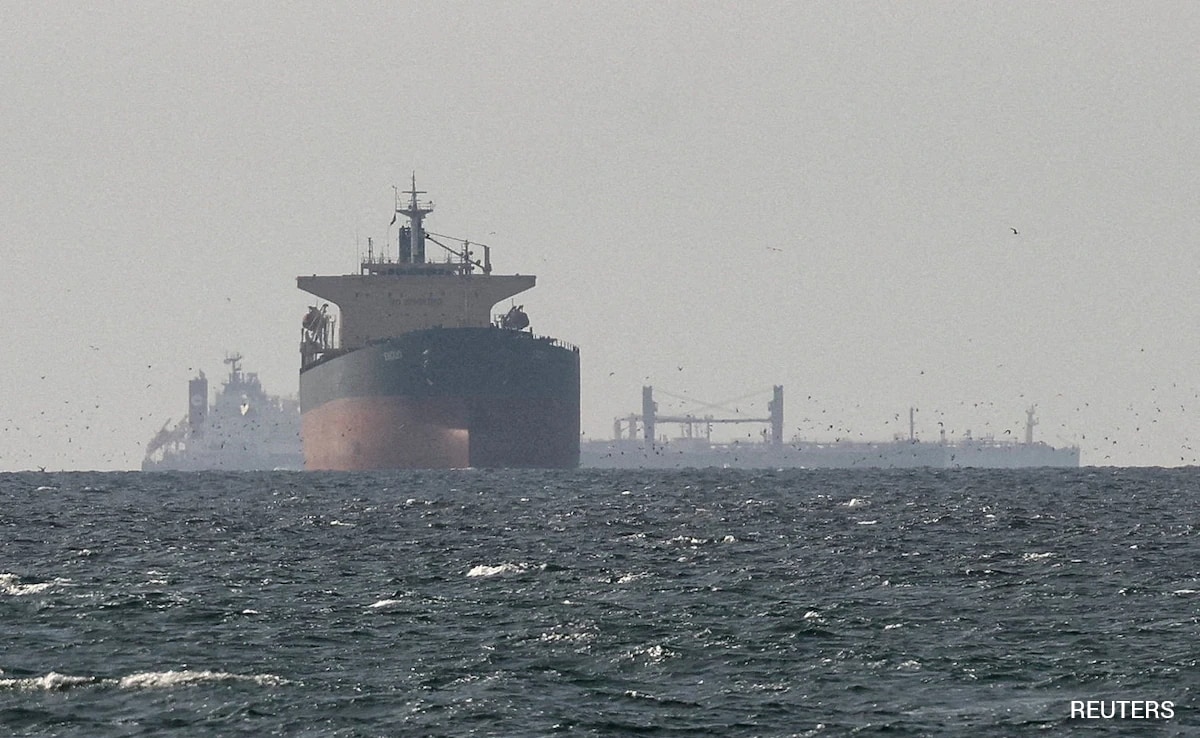
The headlines are screaming about a "pause" in sanctions as if the White House suddenly found a conscience or lost its nerve. They tell you that soaring prices at the pump forced a desperate administration to look the other way while Iranian tankers sneak through the Strait of Hormuz.
They are wrong.
There is no pause because the sanctions were never meant to be a total blockade. The current narrative suggests a binary world where sanctions are either "on" or "off." In reality, the global energy market is a theater of managed hypocrisy. Washington isn't "pausing" sanctions; it is recalibrating a pressure valve to prevent a global economic cardiac arrest. If you think the goal of US energy policy is to zero out Iranian exports, you’ve been reading the wrong briefing notes.
The Ghost Fleet is a Feature Not a Bug
Critics point to the "Ghost Fleet"—the hundreds of aging, black-listed tankers moving Iranian crude under Panamanian or Cook Islands flags—as a failure of enforcement. I’ve watched analysts wring their hands over satellite imagery of ship-to-ship transfers in the Malacca Strait, claiming the US is being "outsmarted" by middleman traders in Dubai and Singapore.
Nonsense.
The US Treasury knows exactly where these ships are. They have the coordinates, the hull numbers, and the banking trails. They allow the Ghost Fleet to exist because it provides a necessary, unacknowledged service: it keeps the world’s marginal oil supply high enough to prevent $150 Brent.
If the US actually enforced a 100% airtight embargo on Iranian oil, they would effectively be sanctioning their own voters. High oil prices are the most efficient way to lose an election. By maintaining the pretense of strict sanctions while allowing "leakage," the administration gets to keep its hawkish credentials for the cameras while keeping the global economy on life support behind the scenes.
The China Trap
The competitor's piece suggests the US is worried about "soaring prices." That’s only half the story. The deeper issue is the total ceding of the Iranian market to Beijing.
Right now, roughly 90% of Iran’s exported crude goes to "teapots"—independent Chinese refineries. These refineries don't use the US dollar. They don't use Western insurance. They operate in a closed loop that is increasingly immune to traditional financial warfare.
By pushing for "stricter" sanctions now, the West doesn't actually stop the oil; it just forces the trade further underground where it becomes even more opaque. Every time a new sanction is layered on without a real enforcement mechanism, the US loses a tiny bit more of its ability to monitor the flow of energy.
The "pause" isn't a retreat. It's a realization that you can't control what you can't see.
The Math of Volatility
Let’s look at the actual numbers. Global demand is hovering around 102 million barrels per day. Iran is currently producing roughly 3.2 million barrels per day, exporting about half of that.
In a tight market, that 1.5 million barrels of "sanctioned" oil is the difference between a manageable price spike and a systemic collapse. If that volume disappears tomorrow, the spare capacity left in the world—mostly held by Saudi Arabia—would be stretched to its absolute limit.
Imagine a scenario where a technical glitch or a drone strike hits a major Saudi processing facility like Abqaiq while Iranian oil is already offline. We aren't talking about $5 gas. We are talking about the breakdown of global logistics.
The administration isn't being soft on Tehran. They are being terrified of a world where the SPR (Strategic Petroleum Reserve) is already depleted and there is no backup plan.
The Misconception of Energy Independence
Politicians love the phrase "energy independence." It’s a lie. Oil is a fungible global commodity. Even if the US produces more than it consumes, the price is set by the global marginal barrel. If Iranian oil stops moving at sea, the price of West Texas Intermediate (WTI) in Midland, Texas, goes up just as fast as the price of Iranian Heavy in Ningbo.
The "insider" secret that no one wants to admit is that the US shale patch is no longer the swing producer. Wall Street demanded capital discipline. Drillers can't just flip a switch and flood the market to offset a geopolitical shock.
That leaves the "rogue" barrels. Iranian, Venezuelan, and Russian oil are the ugly, necessary components of the modern energy mix.
Why "Strict Enforcement" is a Fantasy
Whenever a politician demands "maximum pressure," they are ignoring the physics of the ocean.
To actually stop Iranian oil, the US Navy would have to physically interdict ships in international waters. That is an act of war. Short of that, you are playing a game of whack-a-mole with shell companies.
I have seen firms in the UAE change their names four times in a single quarter just to stay one step ahead of OFAC (Office of Foreign Assets Control) designations. By the time the paperwork is filed in DC, the oil has already been refined into gasoline in Shandong.
The current "pause" is simply an admission of reality. It’s the sound of a superpower realizing its primary weapon—the dollar—is losing its edge in the energy sector.
Stop Asking if Sanctions Work
You’re asking the wrong question. People always ask: "Are the sanctions hurting Iran's economy?"
Of course they are. Iran is struggling with massive inflation and a devalued currency. But that was never the goal of the global oil market. The market doesn't care about Iranian democracy or nuclear centrifuges. The market cares about flow.
The real question is: "Can the world afford for these sanctions to actually work?"
The answer, as evidenced by the quiet stand-down of enforcement, is a resounding no. The US is currently the biggest beneficiary of its own "failed" sanctions. It gets to take the moral high ground while the "black market" ensures the lights stay on in Europe and Asia.
If you are an investor or a policy observer, stop waiting for the "crackdown." The crackdown is the theatre. The leakage is the policy.
Buy the dip when the headlines claim "Strict Sanctions Coming," because the people in the rooms that matter know they can't afford to actually pull the trigger. They need that Iranian crude. They just don't want to tell you they need it.
Quit looking for a shift in foreign policy and start looking at the shipping manifests. The ships aren't stopping because the world is too hungry to let them.
The greatest trick the energy lobby ever pulled was convincing you that sanctions are about stopping oil, when they’ve always been about controlling who gets to profit from it.