The rain in the Lake District doesn't just fall. It possesses a weight, a relentless grey gravity that blurs the line between the sky and the sodden earth of the fells. For centuries, the people of Wasdale have moved through this damp silence, their lives etched into the slate and scree. They walk past walls that have stood since the Middle Ages, often without a second glance. We have a habit of ignoring the things that have always been there. We assume that because a building is humble, its story must be short.
We were wrong.
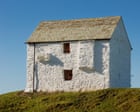
Deep in the heart of this glacial valley, tucked away like a forgotten thought, stands a barn. To the casual hiker heading toward the jagged peaks of Scafell Pike, it is just another piece of the agricultural scenery—a sturdy, windowless box of fieldstone and slate. But historians and heritage experts have recently looked closer, peeling back the layers of moss and anonymity. What they found wasn't just a shed for livestock. They found a time capsule.
Historic England has officially added this "mysterious" Wasdale barn to the National Heritage List, granting it Grade II listed status. It isn't listed because it is grand. It is listed because it is a survivor.
The Architect of Necessity
Imagine a farmer in the late 1600s. Let’s call him Thomas. Thomas didn’t have a degree in structural engineering, and he certainly wasn't thinking about "national treasures." He had a more pressing problem: the winter. In Wasdale, the wind screams through the mountain passes with enough force to scour the skin off your face. Thomas needed a place to keep his heather-fed sheep safe and his precious hay dry.
He didn't go to a timber yard. He went to the ground.
Thomas gathered the stones cleared from his own fields—erratics dropped by retreating glaciers ten thousand years ago—and began to stack. This wasn't "construction" in the modern sense. It was an act of communion with the geography. The barn he built used a technique known as "dry stone," where gravity and friction do the work of mortar. If you look at the walls today, you can see the logic of his hands. Large, heavy "through-stones" span the width of the wall to tie the inner and outer faces together. Smaller hearting stones fill the gaps.
There is a specific, tactile honesty in a building like this. If a stone is placed poorly, the wall falls. There is no paint to hide a mistake, no drywall to cover a shortcut. The barn is a record of a man’s competence and his desperate need to protect his livelihood.
A Geometry of Shadows
What makes this specific barn a "mystery" to the experts who cataloged it is the internal layout. Most Cumbrian barns follow a predictable pattern: a place for the cattle (the lowing) and a loft for the hay. But this structure defies the standard blueprints of the seventeenth century.
The interior is divided by internal stone partitions that suggest a sophisticated, almost obsessive, management of space and airflow. There are "boose" stones—slabs used to create stalls—that are worn smooth by the flanks of animals that haven't existed for two hundred years. The floor is a masterclass in drainage, tilted just so to ensure that the damp of the Lake District stayed on the outside, or at least moved quickly toward the exit.
Walking inside is an exercise in sensory deprivation and sudden clarity. The air is cool and smells of ancient dust, damp wool, and the faint, sweet ghost of dried grass. When the door swings shut, the roar of the Cumbrian wind vanishes. You are encased in two feet of solid mountain. It is quiet. It is safe.
This is why the listing matters. We are obsessed with the "Big History"—the palaces of kings, the cathedrals of bishops, the battlefields where borders were redrawn. We forget the "Small History." But the Small History is what actually built the world we inhabit. The Wasdale barn is a monument to the endurance of the commoner. It is a testament to the fact that for most of human existence, beauty was secondary to survival, and yet, through sheer craftsmanship, survival became beautiful.
The Invisible Stakes of a Fallen Stone
You might wonder why a government agency bothers to put a legal ring-fence around a pile of old rocks in a sheep pasture. The answer lies in the fragility of our memory.
Once a building like this loses its roof, it has roughly twenty years before it becomes a ruin. Once the rain gets into the core of a dry-stone wall, the frost begins its work. Water enters the gaps, freezes, expands, and pushes the stones apart. A single "bulge" in the masonry is the beginning of the end. Within a few seasons, the "Small History" of Thomas and his sheep collapses into a heap of anonymous rubble, indistinguishable from the scree on the mountainside.
By listing the barn, we are making a collective promise. We are saying that this specific arrangement of stones is worth more than the sum of its parts. It is a physical anchor. In a world that feels increasingly digital, ephemeral, and untethered, the Wasdale barn is stubbornly real. It is a reminder that we come from people who knew how to build things that lasted three centuries without the help of electricity or global supply chains.
The Living Landscape
The Lake District is often treated like a museum or a theme park for hikers. We drive up from London or Manchester, walk the trails, take photos of the "untouched" wilderness, and go home.
But the wilderness isn't untouched. It is a managed, working landscape. Every "wild" fell has been grazed. Every "natural" valley has been shaped by the hands of people like Thomas. The mystery barn is a vital organ in that living body. It tells us that the relationship between humans and the environment hasn't always been one of extraction and destruction. Sometimes, it was a partnership.
The barn was built from the mountain to protect life from the mountain.
Now, as it joins the ranks of Stonehenge and the Tower of London on the national register, it stands as a challenge to our modern sensibilities. We build houses designed to last forty years. We buy phones designed to break in three. We live in a disposable culture.
Then there is the barn.
It sits in the rain, indifferent to the passage of centuries. It doesn't need an internet connection. It doesn't need an upgrade. It just needs its roof maintained and its stones respected. It is a silent witness to the generations of Wasdale folk who have looked up at the same peaks and felt the same biting cold.
As the sun sets over Wastwater, casting long, purple shadows across the valley floor, the barn seems to settle deeper into the earth. It isn't a relic. It isn't a "treasure" in the sense of gold or jewels. It is something far more valuable. It is a bridge.
The next time you find yourself in the shadow of Scafell, look for the small things. Look for the grey walls that look like they grew out of the ground. Reach out and touch the stone. It is cold, rough, and wet. It is the weight of three hundred years of survival, holding steady against the wind.