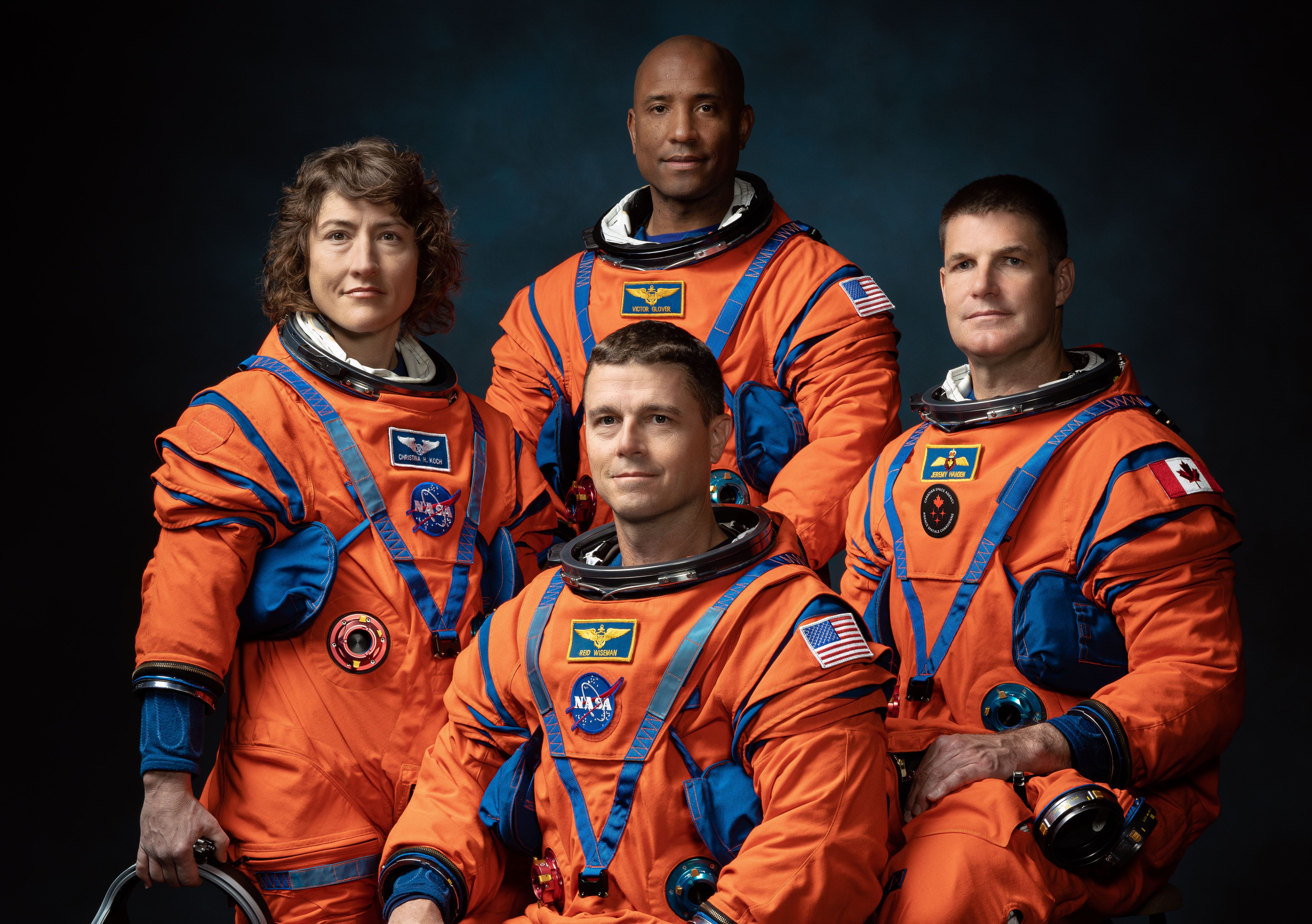
The completion of 66% of the Artemis II outbound trajectory marks a critical phase-shift from energy-intensive acceleration to the precision-governed mechanics of lunar approach. While traditional reporting focuses on the chronological progression of the mission, the true success of this flight path is measured through the lens of kinetic energy management, thermal equilibrium, and the structural integrity of the Orion MPCV (Multi-Purpose Crew Vehicle) during the transition from the Earth-dominant to the Moon-dominant gravity well.
The Gravity Well Inflection Point
The journey to the moon is not a linear distance problem; it is a potential energy negotiation. At the two-thirds mark, the Orion spacecraft has crossed the point of maximum deceleration relative to Earth. The mission's trajectory logic is built upon three primary physical constraints:
- Translunar Injection (TLI) Accuracy: The initial velocity vector determined the entire fuel budget for the remainder of the mission. Any deviation in the first 10% of the flight requires exponential correction costs in the final 30%.
- The Lagrange Point Proximity: As Orion approaches the moon, it enters a region where Earth’s gravitational pull ($F_e$) begins to equalize with the Moon’s ($F_m$). This transition requires active attitude control to prevent unintended rotation caused by the shifting gravitational gradient.
- The Thermal Soak Phase: Spending over 48 hours in deep space exposure creates a massive thermal differential between the sun-facing side and the dark side of the spacecraft.
The "two-thirds" milestone is the functional boundary where the Service Module (SM) transitions from a propulsion-heavy role to a life-support and navigation-dominant role.
Life Support Systems and Metabolic Load Balancing
Artemis II represents the first human-rated test of the Orion Environmental Control and Life Support System (ECLSS) in a high-radiation environment beyond the Van Allen belts. Most analysis ignores the relationship between crew metabolic rates and the carbon dioxide scrubbing capacity over long-duration transits.
The ECLSS must maintain a partial pressure of oxygen ($ppO_2$) while simultaneously managing the buildup of $CO_2$ and water vapor. At this stage of the mission, the cabin atmosphere reaches a steady state. The performance of the amine-based swing-bed scrubbers is the primary metric here. Unlike the International Space Station, which uses larger, more power-intensive systems, Orion’s scrubbers must operate within a strict mass-volume-power constraint.
A failure in the "swing" timing—the cycle where one bed collects $CO_2$ while the other vents to space—would lead to a rapid spike in cabin acidity. At the 66% mark, the data confirms the system's ability to handle the "peak load" of four active astronauts exercising and consuming oxygen, which is the most strenuous test of the atmospheric loop.
Radiation Shielding and Solar Particle Events (SPE)
Outside the protection of Earth's magnetosphere, the crew is vulnerable to Galactic Cosmic Rays (GCR) and potential Solar Particle Events. The Artemis II flight path intersects with peak solar cycle activity, making the radiation data gathered during this two-thirds stretch the most valuable dataset for future Mars missions.
Orion utilizes a "shelter-in-place" strategy. Instead of heavy lead shielding, which is weight-prohibited, the mission uses the spacecraft's internal mass—water containers, food supplies, and equipment—to create a localized storm shelter in the center of the capsule. The efficacy of this mass-shielding is monitored via the HERA (Hybrid Electronic Radiation Assessor). This system provides real-time warnings, allowing the crew to optimize their positioning relative to the incoming particle flux.
The structural logic is clear: mass is a multipurpose asset. Every kilogram of water consumed by the crew reduces the shielding effectiveness of the storage tanks, requiring a dynamic reconfiguration of the internal cabin layout to maintain a consistent radiation protection factor.
Navigation and the Optical Communication Link
As Orion nears the moon, the reliance on the Deep Space Network (DSN) for telemetry remains absolute, but Artemis II is also testing the Optical Communications System (O2O). This system uses laser-based data transmission, which offers bandwidth far exceeding traditional S-band or Ka-band radio frequencies.
The complexity of this link increases with distance. At the two-thirds mark, the "pointing, acquisition, and tracking" (PAT) requirements become surgical. The laser must hit a ground station receiver from over 300,000 kilometers away while the spacecraft is traveling at thousands of kilometers per hour.
This is not merely a "tech demo." It is a fundamental shift in how deep-space missions will operate. High-definition video and massive telemetry streams are required for the real-time troubleshooting of the Life Support Systems mentioned earlier. If the O2O link maintains stability at this range, it validates the communication architecture for the Artemis III landing.
The Return-to-Earth Contingency Logic
The two-thirds mark is the final "Low-Energy Abort" window. Beyond this point, the physics of the mission dictate that continuing around the moon (a Free-Return Trajectory) requires less fuel than attempting a 180-degree turn to head back to Earth.
The propulsion system, specifically the Aerojet Rocketdyne AJ10-190 engine on the Service Module, has been "cold-soaked" for days. Its reliability is paramount. If a major system failure occurred now, the crew would be committed to a lunar flyby. This phase of the mission is characterized by "Passive Safety." The spacecraft’s orbit is designed so that even if all propulsion is lost, Earth’s gravity will eventually pull the capsule back into the atmosphere for a splashdown, albeit with less control over the landing site.
Structural Fatigue and Deep Space Vacuum Cold-Welding
The vacuum of space presents a unique challenge to mechanical interfaces: cold-welding. In the absence of an atmosphere, the thin oxide layers that usually prevent metals from sticking together can dissipate. Any moving part—hatches, solar array drive mechanisms, or docking latches—is susceptible.
Artemis II is the first mission to subject these specific European Service Module (ESM) components to extended vacuum exposure while under human-occupied thermal loads. The expansion and contraction of the hull ($\Delta L = \alpha L \Delta T$) creates micro-stresses at the bolt points. The 66% milestone serves as a baseline for measuring the cumulative effect of these thermal cycles before the high-G maneuvers of the lunar slingshot begin.
Communication Latency and Autonomy Protocols
As the distance from Earth increases, the round-trip light time (RTLT) for signals grows. While 1.3 seconds sounds negligible, it introduces a "control loop lag" in sensitive maneuvers. At the two-thirds mark, the crew and the onboard computers take on higher levels of autonomy.
The flight software must be capable of executing Mid-Course Correction (MCC) burns with minimal ground intervention. This transition from "Ground-Controlled" to "Pilot-Vetted" operations is a psychological and technical hurdle. The crew must trust the onboard Inertial Measurement Units (IMUs) and Star Trackers more than the data coming from Houston, as the Houston data is always "old news" by the time it arrives.
The Slingshot Calculus
The remaining third of the outbound journey is defined by the Lunar Influence Sphere. Orion will accelerate as the Moon’s gravity becomes the dominant vector. The objective is to use the Moon’s mass to whip the spacecraft into a High Earth Orbit for the return leg.
This maneuver requires a precise "Pericynthion" (the point of closest approach). If the approach is too shallow, the spacecraft skips off the lunar gravity well and heads into a heliocentric orbit (orbiting the sun), resulting in crew loss. If the approach is too steep, the spacecraft risks lunar impact or an unrecoverable energy loss that prevents it from reaching Earth's atmosphere on the return.
The focus for the final 100,000 kilometers shifts to the Optical Navigation (OpNav) cameras. These cameras take images of the Moon and Earth against known star fields to triangulate Orion’s position independent of the DSN. This redundant system is the ultimate fail-safe for deep space navigation.
The strategic imperative now is the preservation of the Service Module's fuel margins. Every gram of propellant saved during the outbound mid-course corrections is a gram available for the critical Earth Entry Interface burn. The mission is no longer about reaching the moon; it is about managing the energy required to leave it. Operators must prioritize heat shield health over minor trajectory optimizations, ensuring the thermal protection system remains uncompromised by micro-meteoroid or orbital debris (MMOD) strikes during this final, vulnerable approach.