The media is obsessed with a surface-level contradiction that doesn't actually exist. They point at Donald Trump, point at his recent friction with the Vatican, and then clutch their pearls when he utilizes messianic imagery. They call it blasphemy. They call it a breakdown of logic. They are wrong.
This isn't a breakdown of logic; it’s a masterclass in post-institutional branding.
The lazy consensus suggests that a politician cannot simultaneously attack the Pope and cast himself as a Christ-like figure. This assumes that the modern American religious voter cares about the hierarchy of the Holy See. They don't. We are witnessing the final divorce between "faith" and "institution." If you're looking at this through the lens of traditional Sunday school ethics, you’ve already lost the plot.
The Papal Irrelevance Engine
When Trump spars with Pope Francis, he isn't attacking Christianity. He is attacking a globalist bureaucracy. To the base he has cultivated, the Vatican is just another "alphabet agency" like the FBI or the WHO—an unelected, international body trying to dictate terms to sovereign individuals.
Critics argue that attacking the Vicar of Christ should alienate the Catholic vote. This is a fundamental misunderstanding of the American religious landscape. The "battle scars" of the last decade show us that identity politics has cannibalized theology. I have sat in rooms with political strategists who spent millions trying to "flip" religious cohorts based on specific doctrinal shifts, only to realize those voters don't follow the doctrine; they follow the man who validates their grievances.
The Pope represents a top-down, globalized morality. Trump represents a bottom-up, nationalist martyrdom. In the eyes of his supporters, the Pope is a "leftist" institutionalist. Therefore, attacking the Pope isn't an act of heresy—it's an act of purification.
The Mechanics of Secular Martyrdom
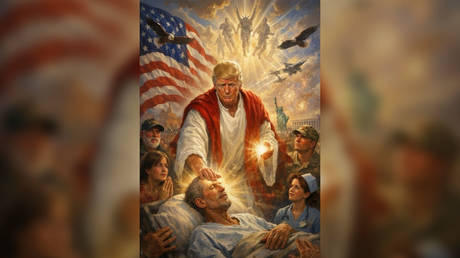
Why the Jesus imagery? Why the AI-generated photos of a stoic, persecuted figure in a courtroom that mirror the Stations of the Cross?
It is a psychological bypass.
By adopting the aesthetics of the messianic, Trump moves the conversation from "Did he commit a crime?" to "Is he being sacrificed for you?"
- The Trial as the Passion: Every legal filing becomes a lash.
- The Mugshot as the Icon: A defiant image meant to be hung in the homes of the faithful.
- The Media as the Pharisee: The establishment that seeks to preserve its power by destroying the outsider.
This isn't an accidental ego trip. It is a calculated use of the most powerful narrative structure in Western history. When the competitor articles focus on the "cringe" factor of AI-generated Jesus memes, they miss the efficacy. These images aren't for the art critics; they are for the person who feels that their way of life is under an existential threat.
The Fallacy of the "Hypocrisy Trap"
"How can they support a man who acts nothing like Jesus?"
This is the most common question in the "People Also Ask" sidebar of political discourse. It’s a flawed premise. Voters aren't looking for a Sunday School teacher; they are looking for a David. They want a flawed, aggressive warrior who can slay the Goliaths of the "Deep State."
In this framework, the flaws aren't a bug; they’re a feature. They make the "sacrifice" more relatable. If a perfect man is persecuted, it’s a tragedy. If a billionaire who "has it all" allows himself to be dragged through the mud for the sake of a construction worker in Ohio, it’s a redemptive arc.
AI Imagery and the Death of Literalism
The use of AI-generated religious imagery is the final nail in the coffin of "objective truth" in political campaigning. These images—showing Trump surrounded by light or walking with a digital Christ—operate on an emotional frequency that a standard press photo cannot reach.
The media tries to "fact-check" a feeling. You cannot fact-check a metaphor.
When a supporter shares an AI image of Trump as a savior, they aren't saying, "I literally believe this man is the Second Coming." They are saying, "This image represents how I feel about the weight he is carrying for me."
The establishment's insistence on literalism is why they keep losing the narrative war. They are playing checkers against a guy who has turned the entire board into a cathedral.
The Religion of No Religion
We are now in the era of the "Political Church."
Traditional denominations are hemorrhaging members, but political rallies are fuller than ever. The liturgy has been replaced by the stump speech. The hymns have been replaced by the chant.
Trump hasn't "cast himself" as Jesus in a vacuum; he has filled a void left by the collapse of institutional trust. When the church, the media, and the government all seem to be reading from the same script, the man who tears the script up and burns it becomes the only "authentic" thing left.
Even if you find the imagery distasteful—and from a traditional theological standpoint, it is undeniably blasphemous—you have to acknowledge its power. It provides a sense of cosmic significance to a political movement. It turns a vote into a prayer and a donation into an offering.
The Danger of the Counter-Attack
The biggest mistake the opposition makes is trying to use the Bible against him. When secular pundits start quoting scripture to prove Trump isn't "Christian," the base smells the insincerity from a mile away. It feels like an appropriation of their culture by people who usually despise it.
The only way to dismantle a messianic narrative is to ignore the messiah and focus on the mechanics of the "miracles"—or the lack thereof. But the media can't help themselves. They are addicted to the outrage. They feed the martyrdom. Every time they scream "Blasphemy!" they are just adding another station to the cross.
Stop asking if he’s a "good Christian." Start asking why the institutions meant to provide meaning have failed so spectacularly that a real estate mogul in a suit has become the primary vessel for American spiritual longing.
The imagery isn't the problem. The vacuum is.
The institutions are dead. The icons are digital. The martyrdom is televised. If you’re still waiting for a "return to normalcy" or a "reclaiming of faith," you’re staring at a ghost. The new religion is here, and it doesn't need a Pope's blessing. It doesn't even need a god. It just needs a victim and a camera.