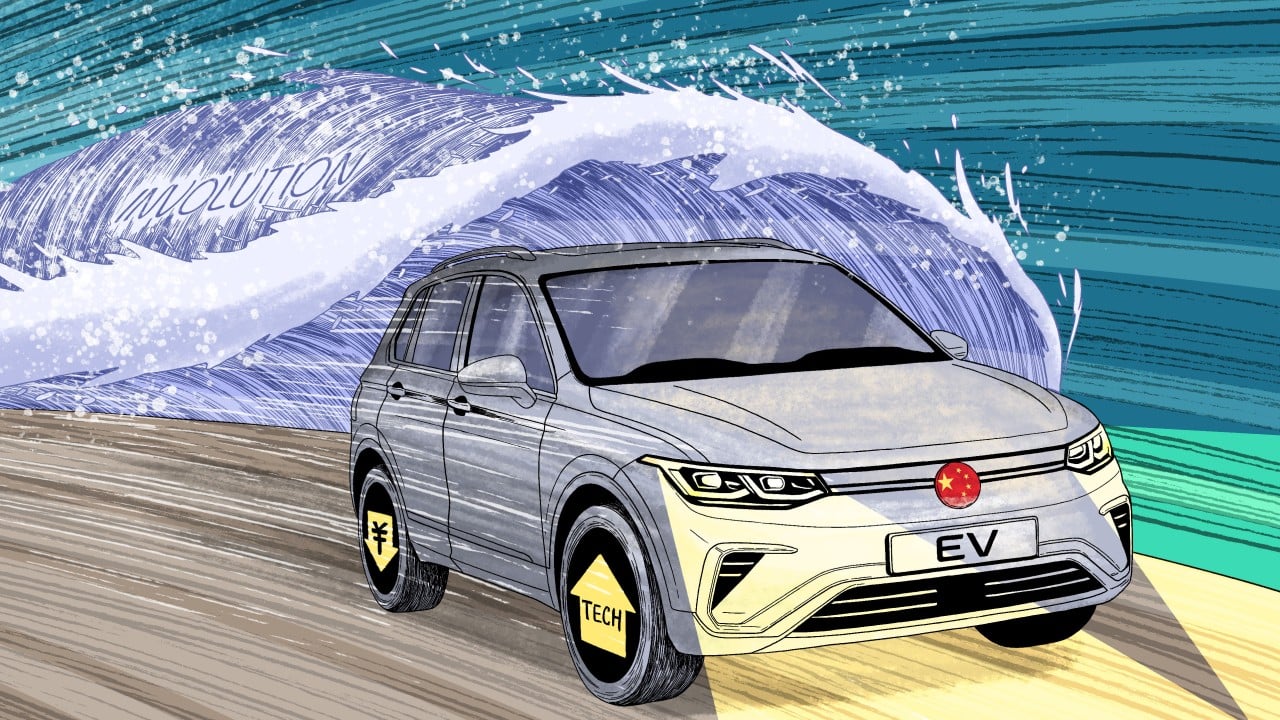
The current Chinese Electric Vehicle (EV) market is defined by a negative-sum game where price reductions have outpaced manufacturing efficiencies. While surface-level analysis attributes the ongoing price wars to simple overcapacity, the structural reality is a deliberate, high-stakes transition from "Growth at All Costs" to "Survival via Vertical Integration." To understand how specific players intend to outrun this attrition, one must deconstruct the industry into three distinct strategic pillars: the optimization of the marginal cost curve, the monetization of the software stack, and the aggressive pivot toward high-margin export jurisdictions.
The Mathematics of Marginal Cost Dominance
In a price war, the victor is not the company with the best brand, but the one with the lowest floor on their variable cost per unit. Most Chinese EV manufacturers are currently trapped in a cycle where every vehicle sold at a discount erodes their ability to fund R&D. To break this, leaders like BYD and specialized newcomers have shifted toward extreme vertical integration.
The cost function of a modern EV is heavily weighted toward the battery pack and the power electronics, often representing 30% to 40% of the total Bill of Materials (BOM). Companies that rely on Tier 1 suppliers like CATL for finished battery packs are structurally disadvantaged. They pay a supplier margin that their vertically integrated competitors have internalized.
By manufacturing their own cells, semiconductors (specifically SiC MOSFETs), and thermal management systems, integrated firms can achieve a 15% to 20% cost advantage over "assembler" peers. This margin provides a "buffer zone" that allows them to match price cuts while remaining contribution-margin positive. The second-order effect of this integration is the speed of iteration. When the hardware and software teams work under one roof, the time to implement a more efficient motor or a lighter chassis is halved, allowing the firm to refresh its product lineup before the market reaches price saturation for the previous model.
The Software-as-a-Service Pivot and L3 Autonomy
Hardware is rapidly becoming a commodity. To escape the "commodity trap," manufacturers are looking toward recurring revenue streams through Advanced Driver Assistance Systems (ADAS) and eventually Level 3 (L3) autonomous driving subscriptions. The logic is simple: if you cannot make a significant profit on the sale of the metal, you must make it on the life of the software.
This transition involves a shift in how vehicle value is perceived:
- Hardware Value: Depreciates rapidly; subject to intense competitive pricing.
- Software Value: High-margin (80%+); scales with the size of the active fleet; provides "stickiness" through ecosystem locks.
Manufacturers are now front-loading their vehicles with excess compute power—often utilizing dual Orin-X chips or proprietary silicon—even if the software isn't ready. This is a strategic bet on "future-proofing." By selling a car today with the hardware capable of tomorrow’s autonomy, the manufacturer creates a captive audience for future high-margin OTA (Over-the-Air) updates. The primary bottleneck here is not the code itself, but the data flywheel. Companies with a larger fleet of "connected" cars on the road gather more corner-case data, which improves their neural networks faster, leading to a superior autonomous product that justifies a premium price, effectively decoupling the car's price from its physical production cost.
Geographical Arbitrage and Export Realities
The domestic Chinese market is a bloodbath of sub-15% gross margins. In contrast, the European and Southeast Asian markets offer a "margin oasis." A vehicle that sells for 200,000 RMB in Shanghai can often command the equivalent of 350,000 RMB in Munich or Bangkok, even after accounting for logistics and tariffs.
This creates a strategy of "Domestic Defense, International Offense." Manufacturers use their high-volume domestic sales to achieve economies of scale and drive down the unit cost of components. They then "export" that scale to international markets where the competitive intensity is lower and the price ceiling is higher.
However, this strategy faces three significant friction points:
- Geopolitical Protectionism: The imposition of anti-subsidy duties by the EU and other regions threatens to erase the price advantage of Chinese imports.
- Localization Costs: Adapting software, safety standards, and marketing for diverse global regions requires significant localized CAPEX.
- Brand Equity Deficit: While Chinese EVs are technically superior in terms of infotainment and battery range at certain price points, they lack the legacy trust of European or Japanese incumbents.
The Capital Structure of Attrition
The ability to survive a price war is ultimately a function of the balance sheet. In the Chinese context, this is complicated by the presence of state-backed entities and massive venture capital infusions. The market is currently seeing a "Liquidity Darwinism" where companies with deep cash reserves or direct lines to provincial government funding can afford to lose money on every car sold for several years.
For a private or listed EV firm, the metrics that matter are "Cash Runway" and "Burn Rate per Delivery." If a company is burning $10,000 per vehicle and has $2 billion in cash, it has a finite window to achieve the scale necessary for the cost curves to cross. The players most at risk are the "mid-tier" brands that have neither the massive scale of BYD nor the "luxury" margins of Li Auto. They are stuck in a volume-margin pincer movement: they lack the volume to negotiate deeper supplier discounts and lack the brand power to resist price cuts.
Structural Efficiency through Platform Modularization
To further combat price erosion, the industry has moved toward hyper-modular platforms. Instead of designing a new chassis for every model, manufacturers use a single "skateboard" architecture that can support a sedan, an SUV, and a minivan.
The efficiency gains here are twofold. First, it reduces R&D amortized over the life of the platform. Second, it allows for "Flexible Manufacturing," where a single factory line can pivot between different models based on real-time demand signals. This prevents the buildup of inventory, which is the "silent killer" of automotive companies. Excess inventory leads to forced discounting, which further degrades brand value and kills margins. By moving to a "Build-to-Order" or high-flexibility model, the most advanced Chinese makers are minimizing the capital tied up in unsold lots.
The Hydrogen and Hybrid Hedge
While the global narrative focuses on Battery Electric Vehicles (BEVs), the winners in the Chinese market are increasingly those who have hedged their bets with Plug-in Hybrids (PHEVs) and Extended Range Electric Vehicles (EREVs). These vehicles solve "range anxiety"—a major hurdle for the mass-market consumer—while using smaller, cheaper batteries.
The EREV model, popularized by Li Auto, uses a small internal combustion engine solely as a generator to charge the battery. This reduces the BOM because a smaller battery (e.g., 40kWh vs 100kWh) significantly lowers the cost of the vehicle while offering a total range of over 1,000km. In a price war, the EREV is a tactical weapon; it offers the "electric feel" and tech-heavy interior consumers want, but at a price point that BEVs struggle to match without losing money.
Strategic Deployment of the "Intelligence" Stack
The final differentiator in this war is the shift from "Electric" to "Intelligent." The Chinese consumer increasingly views the EV not as a transportation device, but as a mobile living space. This has led to a feature war: 4K screens, reclining "zero-gravity" seats, and integrated AI assistants.
The competitive advantage here lies in the "Software-Hardware Integration." Traditional OEMs (Original Equipment Manufacturers) often struggle because their software is siloed from the mechanical systems. Chinese leaders are building unified operating systems that control everything from the suspension stiffness to the air conditioning. This level of integration allows for features that are difficult to replicate—such as a car that automatically adjusts its ride height and cabin temperature based on a user's calendar invite—creating a moat that is based on user experience rather than just horsepower or range.
The Final Strategic Play
The survivors of the Chinese EV shakeout will not be the ones who cut prices the deepest, but those who successfully execute a three-stage transition.
First, they must achieve a "Critical Mass of Production" (roughly 500,000 units per year) to unlock the bottom end of the manufacturing cost curve. Second, they must transition their revenue model from one-time hardware sales to a mix of hardware and recurring software services. Third, they must diversify their geographic risk by establishing local manufacturing hubs in Europe, South America, or Southeast Asia to bypass trade barriers.
For investors and competitors, the metric to watch is the "Efficiency Ratio": the R&D spend required per kilometer of range added, combined with the "Software Take Rate" (the percentage of customers paying for autonomous features). Companies that show a rising software take rate alongside a falling cost-per-kWh are the ones building a sustainable moat in an otherwise commoditized industry. The era of pure electrification is over; the era of the "Sovereign Software Vehicle" has begun.
Identify the manufacturers whose "Days Sales of Inventory" (DSI) is decreasing while their "Average Selling Price" (ASP) remains stable relative to the market; these are the firms that have successfully decoupled their value proposition from the raw cost of lithium and steel. Use this delta to separate the future market leaders from the casualties of the current attrition cycle.
Would you like me to analyze the specific patent portfolios of the top three Chinese EV makers to determine which has the most defensible "Intelligence" stack?