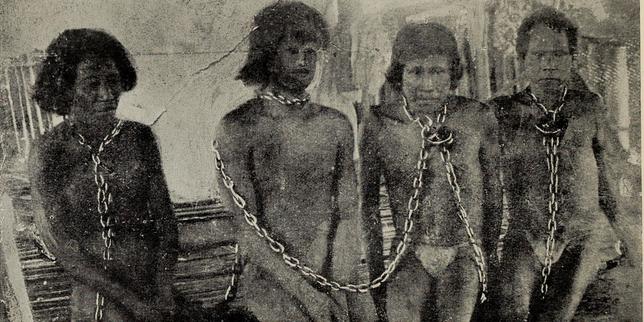
The humidity in the Peruvian Amazon does not just sit on your skin; it breathes with you. It is a heavy, rhythmic weight that carries the scent of decomposing leaves and the sharp, metallic tang of the river. To a traveler, this is the "lungs of the world." To the Huitoto, Bora, and Ocaina people, this soil is a graveyard where the headstones are invisible and the epitaphs are written in the scars of the elderly.
We often talk about the industrial revolution as a series of mechanical triumphs. We picture steam engines and London fog. We rarely picture the forest floor of the Putumayo basin at the turn of the 20th century. Yet, the bicycles of Paris and the Ford Model Ts of Detroit rolled on tires birthed from a nightmare.
Rubber.
It was called oro blanco—white gold. But for the Indigenous families of the Amazon, it was white blood.
The Debt That Never Ends
Imagine a man named Carlos. He is a hypothetical composite of the thousands who lived through the turn of the century, but his story is grounded in the brutal ledger books of the Peruvian Amazon Company. Carlos does not own his body. He is caught in the habilitación system, a predatory cycle of debt that turns a human being into a line item.
The process was simple and devastating. A rubber boss would give Carlos a steel machete, a handful of salt, and a cotton shirt. These items were sold at prices Carlos could never hope to pay. To settle the debt, he had to bring in a specific weight of raw latex. If the rain was too heavy or the trees were exhausted, the debt grew. If he tried to run, the hunters followed.
This wasn't just "business." It was an extraction of the soul.
By 1912, when the British diplomat Roger Casement finally exposed the horrors of the Putumayo, the statistics were numbing. In less than a decade, the population of the region had plummeted from nearly 50,000 to under 10,000. These weren't just casualties of disease. They were victims of a systematic, corporate-sponsored genocide fueled by the world's sudden hunger for elasticity.
The Architecture of a Massacre
The trees themselves, Hevea brasiliensis, are magnificent. They stand tall, their bark grey and mottled. When you slice into them, the latex oozes out—thick, milky, and deceptively innocent.
But during the boom, the tapping wasn't a gentle harvest. It was a frantic, violent scramble. The rubber barons, men like Julio César Arana, built empires on the logic of the whip. They established "stations" deep in the jungle—places with names like La Chorrera and El Encanto. These names, meaning "The Jet" and "The Enchantment," hid the reality of the cepos.
The cepo was a wooden stockade. If a man brought in 10 kilos of rubber instead of 12, he was put in the stocks. If he complained, he was lashed. If he resisted, his family was targeted. This is the part of the history books that often gets sanitized into "labor disputes" or "economic shifts." It was not a shift. It was a slaughter.
The forest has a way of swallowing evidence. Wood rots. Iron rusts. In the humid heat of Peru, a massacre site can be reclaimed by vines and moss in a matter of months. But the memory is different. Memory in the Amazon is oral, passed down through the mambeadero—the ritual space where elders chew coca leaf and tobacco paste to speak with the ancestors.
Why the Silence Persists
You might wonder why this isn't taught in every school, or why there are no towering monuments in Lima to the victims of the Putumayo. The answer lies in the discomfort of the mirror.
To acknowledge the rubber crimes is to acknowledge that the modern world was built on a foundation of bone. The wealth generated by Arana and his peers flowed into the grand architecture of Iquitos and Manaus. It built opera houses where European singers performed for audiences wearing silk in 100-degree heat.
That iron house in Iquitos, designed by Gustave Eiffel himself, stands as a testament to this era. It is beautiful, silver, and cold. It was transported piece by piece from Europe, a symbol of "civilization" dropped into the heart of the "savage" jungle. But the hands that carried those pieces, and the money that bought them, were stained with the latex of the Putumayo.
When you speak to the descendants of the survivors today, there is a profound sense of "living memory." This is not ancient history. For many, it is the story of a grandfather or a great-aunt. They describe the correrías—the slave raids—as if they happened last week.
The trauma is epigenetic. It lives in the way a village grows silent when a stranger asks too many questions. It lives in the deep-seated distrust of extractive industries, whether it is oil, gold, or timber. The actors change, but the script feels hauntingly familiar.
The Myth of the Empty Forest
One of the most dangerous lies told during the rubber boom—and one that persists today—is the "Terra Nullius" myth. The idea that the Amazon was a vast, empty space waiting to be "discovered" and "tamed."
It was never empty. It was a managed, sophisticated ecosystem inhabited by people who understood the chemistry of the plants and the rhythms of the water. The rubber barons didn't just kill people; they killed knowledge. They shattered the social structures that had kept the forest healthy for millennia.
Consider the loss of a single language. When an elder dies without passing on their tongue, a specific way of seeing the world vanishes. A way of describing the medicinal properties of a liana, or the behavior of a specific bird, is erased. During the rubber boom, entire languages were silenced in the span of a single generation.
The forest didn't need taming. It needed respect.
The Modern Echo
The "White Gold" is gone now, replaced by synthetic alternatives and plantations in Southeast Asia. But the ghost of the Putumayo still haunts the supply chain. Today, we see the same patterns in the mining of cobalt for smartphone batteries or the clearing of land for palm oil.
We are still Carlos. We are still the consumers in the distant city, marveling at the new technology while remaining willfully ignorant of the price paid by the person holding the machete.
The Peruvian government has made steps toward apologies, but an apology is a thin bandage for a wound that goes to the bone. True memory is active. It is the restoration of land rights. It is the protection of the remaining uncontacted tribes who fled deeper into the shadows to escape the whips of the 1900s.
The Long Shadow
Walking through the streets of Iquitos today, you can see the faded glory of the rubber mansions. Their azulejo tiles, imported from Portugal, are cracking. The humidity is winning. The forest is slowly reclaiming the stone and the iron.
But go to the river. Look at the water of the Putumayo. It is dark, tea-colored, and deep. It flows toward the Amazon, carrying the sediment of the Andes and the stories of those who were broken on its banks.
There is a specific bird in the region whose call sounds like a mournful whistle. The locals sometimes say it is the spirit of a tapper who never came home. Whether you believe in spirits or not is irrelevant. The fact remains that the ground beneath the canopy is not just earth. It is a witness.
The rubber boom ended not because the world found its conscience, but because the seeds were smuggled out and planted elsewhere, crashing the price. It was an economic conclusion to a human tragedy.
As the sun sets over the canopy, the green turns to a bruised purple. The heat breaks, just for a moment. In that stillness, if you listen past the hum of the insects, you realize that the forest is not silent. It is screaming. It is a long, slow vibration of a century's worth of grief, waiting for someone to finally look at the scars and call them by their real name.
The trees are still there. The scars are still there. We are still driving on the roads they paved.
Would you like me to help you research the specific legal status of Indigenous land claims in the Putumayo region today?