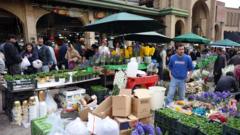
The scent of drying bitter orange blossoms should be the only thing hanging in the Tehran air this week. It is the fragrance of Nowruz, the Persian New Year, a moment when three thousand years of history commands the spring to arrive. In the bustling corridors of the Tajrish Bazaar, the sound usually belongs to the rhythmic clinking of copper smiths and the melodic haggling over the price of Sekkeh—the pristine coins placed on the ceremonial Haft-Sin table.
But this year, the air is heavy with a different frequency. It is the low, vibratory hum of uncertainty.
Maryam is sixty-two. Her hands, stained slightly yellow from rubbing saffron into mounds of basmati rice, are steady, but her eyes keep drifting to the television mounted above her spice stall. She isn't looking for the weather report, though the spring rains are due. She is looking for the trajectory of missiles. For the last forty years, Maryam has navigated the lean seasons of sanctions and the lush seasons of hope, yet the current silence between the headlines feels louder than any previous storm.
"The sprouts are growing," she says, pointing to the Sabzeh—the wheat or lentil germinated in a shallow dish to symbolize rebirth. "But you wonder if they will have a window to sit in by next week."
This is the central paradox of the Iranian psyche in 2026. On one hand, there is the ancient, stubborn commitment to joy. On the other, the mathematical reality of a region balanced on a knife’s edge. To understand the Persian New Year this year is to understand the art of celebrating while holding one's breath.
The Mathematics of a Holiday Table
Nowruz is built on the number seven. The Haft-Sin table requires seven items starting with the Persian letter 'S,' each representing a pillar of existence: rebirth, love, health, patience. But there is an eighth, invisible factor this year: the exchange rate.
Economy is not an abstract graph in Iran; it is a ghost that sits at the dinner table. As tensions with regional powers and the West simmer, the Rial fluctuates like a panicked heartbeat. For a family trying to buy the traditional Sabzi Polo Mahi—herbed rice with fried fish—the cost of the meal has become a feat of financial gymnastics.
Consider the price of pistachios. Once a staple of hospitality, the "smiling nut" has become a luxury item. When the shadow of potential conflict looms, the market reacts instantly. Merchants, fearful of a sudden blockade or a shift in the global oil price, hike their rates to create a buffer. The result is a quiet, domestic erosion. A grandfather who once bought three kilos of sweets for his grandchildren now buys one, wrapped in the same beautiful, gold-embossed paper, hoping they won't notice the lighter weight.
The stakes are invisible until you look at the palms of the shoppers. They are clutching lists, crossing out items that were deemed "essential" only two years ago. The resilience is there, but it is a tired resilience. It is the exhaustion of a marathon runner being told the finish line has been moved another ten miles.
The Sky Above the Courtyard
In the affluent neighborhoods of North Tehran and the crowded alleys of the south, the conversation is the same, whispered over steaming glasses of tea. It centers on the "What If."
For decades, the threat of war has been a background noise, like the drone of a distant lawnmower. You acknowledge it, then you go about your day. But the recent escalations have shifted that noise into the foreground. The rhetoric is sharper. The military drills are more frequent. The drones that once seemed like sci-fi props are now the primary characters in the nightly news.
Hypothetically, imagine a young architect named Reza. He has spent three years saving for a new studio. In any other country, he would be looking at floor plans. In Tehran, he is looking at his passport and then at his mother’s face. If he invests now, and the infrastructure is hit, he loses everything. If he waits, the inflation triggered by the "shadow war" will eat his savings anyway.
Reza’s dilemma is the dilemma of an entire generation. Do you build for a future that might be set on fire? Or do you live purely in the present, spending every cent on a lavish Nowruz because tomorrow isn't promised?
Most are choosing a defiant middle ground. They are buying the hyacinths. They are painting the eggs. There is a profound, almost radical act of rebellion in setting a beautiful table when the news cycle is ugly. It is a way of saying that the culture is older than the conflict. The empire of the hearth is more durable than the empire of the sword.
The Digital Divide of Grief and Hope
While the older generation clings to the rituals, the youth are navigating the tension through the glass of their smartphones. Iran is one of the most digitally connected populations in the Middle East, despite the "filtering" of the internet.
On Instagram and Telegram, the preparation for Nowruz looks different. It is a mix of aesthetic photos of goldfish and grim memes about the cost of living. There is a dark humor that emerges in Persian culture during times of crisis—a sharp, satirical wit that serves as a pressure valve.
"We are the only people who clean our windows so the explosion has a clearer view," one viral post joked. It’s a haunting sentiment, but it captures the grit of a population that has seen empires rise and fall and has decided that, in the meantime, the house must be dusted.
The digital space is also where the "invisible stakes" become visible. It is where the diaspora—millions of Iranians living in Los Angeles, London, and Toronto—connects with the "Inside." The video calls on New Year’s Day will be a tether between those who left to escape the shadow and those who stayed to guard the light. There is a shared grief in the realization that the "shadow of war" doesn't just threaten buildings; it threatens the ability of a family to dream in the same time zone.
The Architecture of Endurance
To understand why Iranians don't simply collapse under this pressure, you have to look at the architecture of their history. This is a land that has been crossed by Alexander the Great, the Mongols, and the tremors of modern revolution. Each time, the response has been the same: a retreat into the domestic.
The Persian garden is a walled sanctuary. Outside, the desert may howl or the enemy may march, but inside, there is a stream, a cypress tree, and the scent of jasmine. Nowruz is the temporal version of that garden. It is a two-week period where the world is forced to stop.
Even the government, with all its geopolitical posturing, cannot stop Nowruz. They must accommodate it. The banks close, the offices empty, and the roads fill with families traveling to see their elders. This year, the migration is happening with a sense of urgency. There is a feeling that this might be the last "normal" one, though they have said that every year since 1979.
The endurance is found in the small details. It is found in the way a woman in Isfahan meticulously sews a new dress for her daughter, even if the fabric was double the price of last year. It is found in the way a father explains to his son that the loud noises in the distance are just the "cleaning of the sky" for the new sun.
A Season of Fire and Light
The festivities actually begin with Chaharshanbe Suri, the Festival of Fire, held on the last Wednesday of the year. People build small bonfires in the streets and jump over them, chanting: "Zardi-ye man az to, sorkhi-ye to az man." My paleness to you, your redness to me.
It is a literal and figurative shedding of the sickness and grayness of the past year in exchange for the warmth and energy of the fire. As sparks fly into the night sky, for a few hours, the "shadow of war" is replaced by the flicker of flame.
But this year, the fire feels more literal. The sparks on the street are a mirror to the potential sparks in the sky. When people jump over the flames, they aren't just performing a rite; they are practicing a survival skill. They are learning how to move through the heat without being consumed.
The world watches Iran through the lens of a satellite—calculating centrifuges, counting barrels of oil, tracking troop movements. But the view from the ground is composed of different units of measurement. It is measured in the milliliters of rosewater poured into a bowl. It is measured in the number of years a mother hasn't seen her son because the borders are too complicated to cross.
The Final Grain of Sand
As the clock ticks toward the exact moment of the vernal equinox—the Tahvil-e Sal—the country will fall into a sudden, eerie silence.
For a few seconds, the 85 million people inside the borders and the millions outside will stop. The merchant in the bazaar, the soldier at the border, the student in the dorm, and Maryam at her spice stall will all look at the Haft-Sin. They will wait for the year to turn.
In that silence, the war doesn't exist. The sanctions don't exist. There is only the ancient, rhythmic pulse of a planet tilting back toward the sun.
The tragedy of the "shadow" is not that it might fall; it is that it forces people to live their most beautiful moments in its shade. Yet, there is a certain power in that shade. It makes the colors of the painted eggs look brighter. It makes the taste of the saffron more intense. It turns a simple holiday into an act of monumental persistence.
Maryam will turn off her television five minutes before the equinox. She will adjust the sprig of hyacinth one last time. She knows that the news will be there when the holiday is over. She knows the planes might fly and the rhetoric might boil over. But for now, the orange blossoms are drying, the sprouts are green, and the table is set.
The sun, indifferent to the movement of armies, will cross the equator. The year will begin. And the people of the plateau will do what they have done for three millennia: they will look at the person next to them, offer a sweet, and wish them a year of light, even as they keep one eye on the darkening sky.
Would you like me to explore the specific cultural rituals of Chaharshanbe Suri or perhaps analyze the economic data behind the current inflation in the Iranian markets?