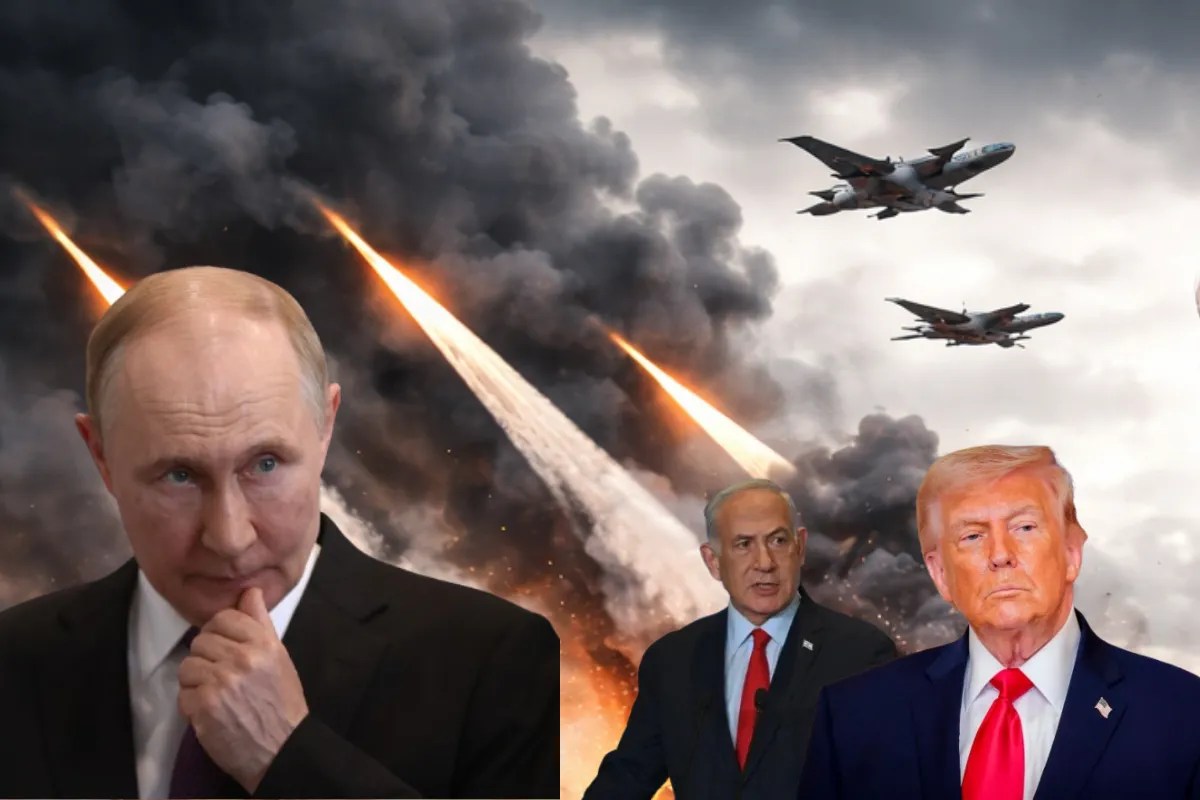
The air in Moscow during a high-stakes press conference doesn't just feel cold; it feels heavy, as if the oxygen itself is being rationed. When Vladimir Putin speaks, the world doesn't just listen for policy. It listens for the vibration of the future. Recently, that vibration turned into a hollow echo. The Russian President, a man whose entire public persona is built on the ironclad certainty of the "Special Military Operation," admitted something that should make every diplomat, soldier, and civilian catch their breath.
He admitted that no one knows what happens next.
This isn't just a political soundbite. It is a crack in the windshield of a speeding car. For years, the narrative from the Kremlin has been a rigid architectural drawing of victory, a mapped-out path toward a specific geopolitical destination. But now, the map has been folded up and tucked away. In its place is a foggy, shifting horizon.
The Kitchen Table Reality
Think about a family in Belgorod or a student in St. Petersburg. For them, the "unpredictability" Putin mentioned isn't an abstract concept discussed in think tanks. It is the reason they don't buy a new car this month. It is the reason a mother stares at her teenage son a little longer than usual across the dinner table.
When a leader says the future is unwritten, he is technically telling the truth, but in the context of a devastating conflict, that truth feels like a weight. Imagine standing on a frozen lake. You know the ice is thick enough to hold you now, but the man who led you onto the ice just told you he can't say for sure where the cracks are forming. You don't turn back, because there is no "back" anymore. You just stand there, waiting for the sound of splintering.
The conflict has moved beyond the simple arithmetic of captured territory and destroyed hardware. It has entered the psychological realm of endurance. Putin’s rhetoric has shifted from "we will achieve X by date Y" to a more somber, almost philosophical stance on the chaos of history. By stating that no one can predict the outcome, he is effectively bracing his population—and the global community—for a state of permanent instability.
The Ghost of 1914
History has a cruel way of repeating its rhythms. In the summer of 1914, the powers of Europe believed they were engaging in a short, sharp adjustment of the status quo. They had plans. They had schedules. They had certainty. Within months, those plans were shredded by the reality of the trenches. The leaders of that era eventually had to admit the same thing Putin just did: the machine they started had grown too large for them to steer.
The current situation in Ukraine has become that machine.
Billions of dollars in Western aid, the rapid evolution of drone warfare, and the shifting alliances of the Global South have created a kaleidoscope of variables. Every time one piece moves, the whole picture changes. Putin’s admission is a rare moment of brutal honesty in a landscape usually dominated by propaganda. It signals that the "planned" phase of this war is over. We are now in the "organic" phase, where the conflict generates its own momentum, independent of the wills of the men who started it.
The Invisible Stakes
We often talk about the stakes of this war in terms of borders. But the invisible stakes are much higher. They involve the very definition of international order. If the outcome is truly unpredictable, then the "rules" we thought governed modern warfare and diplomacy are officially dead.
Consider the soldier in a trench near Donetsk. He isn't fighting for a "multipolar world order" or a "strategic buffer zone." He is fighting because he was told there was a plan. If the architect of that plan now says the blueprint is missing, what does that do to the man holding the rifle? It turns the war from a mission into a tragedy.
The unpredictability also creates a dangerous vacuum for the West. For Washington and Brussels, a predictable enemy is a manageable enemy. You can calibrate your sanctions; you can time your weapons shipments. But how do you react to a leader who has openly embraced the unknown? This shift suggests that Russia is no longer looking for an "exit ramp" because they no longer believe the road has one.
The Language of the Long Haul
The phrasing used by the Russian President—noting that the future is a mystery—is a classic psychological tactic known as "expectation management." If you tell people that victory is around the corner and it doesn't arrive, they revolt. If you tell them that the storm is vast, unpredictable, and potentially endless, they hunker down. They stop asking when it will be over and start asking how they can survive the next day.
It is a pivot from the language of conquest to the language of survival.
This change in tone should be a signal to the world that we are not approaching the end of this chapter. We are likely in the middle of a very long, very dark book. The "facts" of the war—the number of tanks lost, the hectares of land gained—are becoming secondary to the feeling of the war. And that feeling is one of deep, unsettling fog.
The Human Cost of "Maybe"
Human beings can endure immense suffering if they know why they are suffering and for how long. We are hard-wired to seek patterns. We want a beginning, a middle, and an end. By removing the "end" from the narrative, the Kremlin is asking its people to live in a state of suspended animation.
It is a heavy ask.
Behind the grand podiums and the military parades, there is a mounting pile of "maybes." Maybe the economy will hold. Maybe the front lines will remain stable. Maybe the West will grow tired. But "maybe" is a poor substitute for bread, and it is a terrible consolation for a grieving family.
The most chilling part of the statement isn't the admission of ignorance regarding the future. It is the implication that the person at the wheel is no longer trying to steer toward a specific port. He is simply trying to keep the ship upright while the storm decides where it wants to go.
Silence follows a statement like that. Not the silence of peace, but the silence of a breath being held. Somewhere in a small village, a father turns off the television and looks out the window at a horizon that looks exactly the same as it did yesterday, yet feels entirely different. The future hasn't just been delayed; it has been vacated.
We are all now living in the space between the lightning and the thunder. The flash has happened. We are just waiting to see how loud the crash will be.